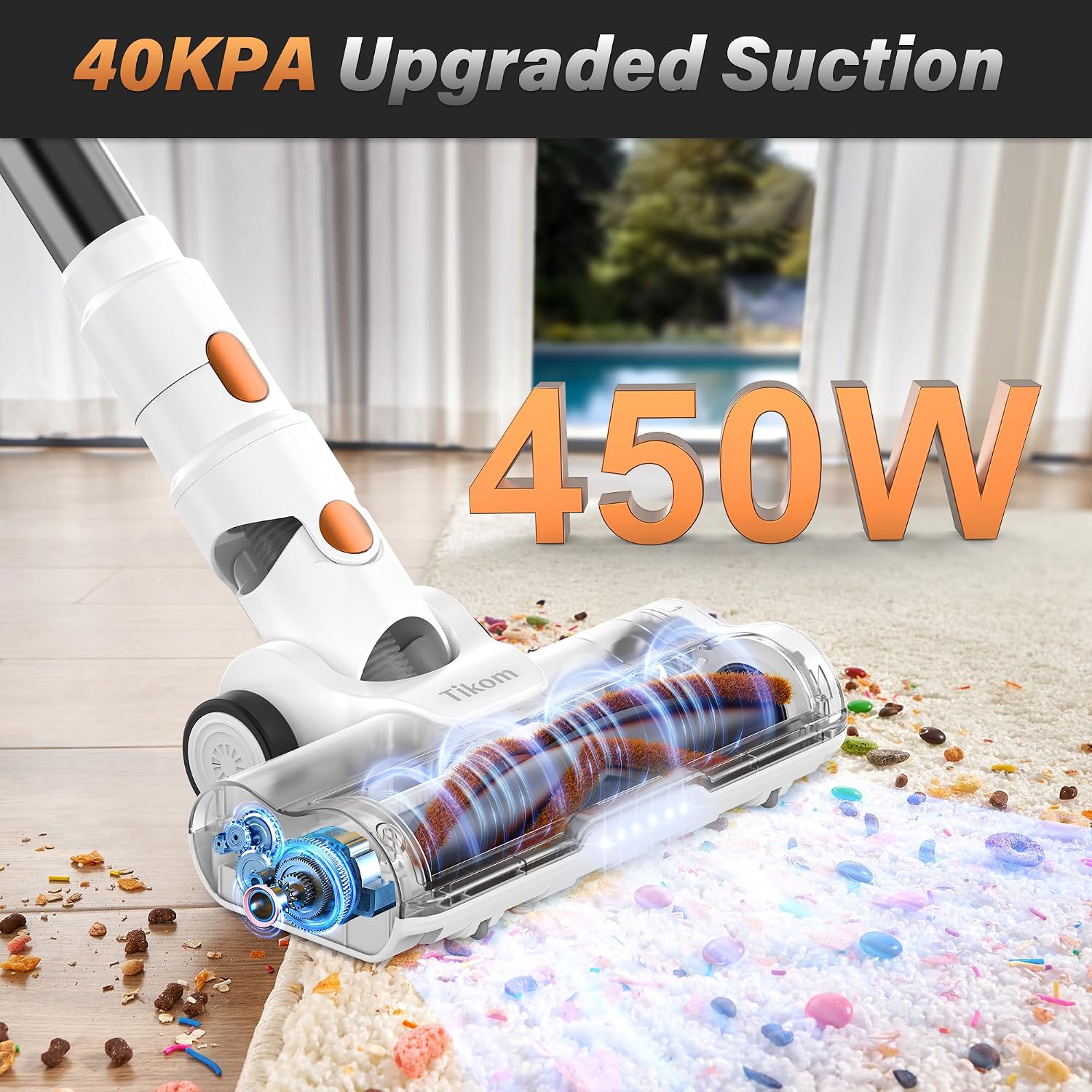
If you’ve been shopping for a cordless vacuum and noticed that a $79 model from a brand you’ve never heard of claims “55,000 Pa suction” while a Dyson V15 at nine times the price shows a modest-looking “230 AW” — you’re not misreading the box. Suction power numbers on budget vacuum packaging are almost never measured the same way as figures from established brands, and they’re rarely measured at all under any standardized test. Pascals (Pa) measure air pressure at the sealed tip of a vacuum’s motor, while airwatts (AW) — the unit Dyson and most premium brands publish — measure useful work across the entire system including the floor head, hose, and filter. Those are two very different things. This article breaks down what the spec sheet on a sub-$150 cordless is actually telling you, where those vacuums genuinely earn their price tag, and where they’ll leave you frustrated mid-job. If you’re running a small cleaning operation or fitting out a secondary property, you’ll find concrete tradeoffs and a decision rule at the end.
| EDITOR'S PICKLEVOIT Cordless Vacuum Cleaner | Mid-tierCHEBIO Lightweight Cordless Vac… | Budget pickTikom V500 Cordless Vacuum Clea… | |
|---|---|---|---|
| Run time | 50 min | 45 min | — |
| Suction | — | 45kPa | 40kPa |
| Wattage | — | — | 450W |
| Self-stand | — | ✓ | — |
| Price | $129.99 | $99.99 | $79.96 |
| See on Amazon → | See on Amazon → | See on Amazon → |
What “55KPa” Actually Measures — and Why It’s Almost Meaningless on Its Own
Here’s the uncomfortable truth that any practitioner should have in their back pocket before spec-shopping: there is no single universal standard that all vacuum manufacturers are required to follow when they publish suction figures. ASTM International’s F558 standard — the closest the industry has to a common test protocol — measures airflow and sealed suction under controlled conditions, but compliance is voluntary and enforcement is nonexistent for import brands selling direct through retail channels.
When a no-name brand prints “55,000 Pa” on its packaging, that figure almost certainly reflects sealed suction — the pressure the motor generates when the airpath is completely blocked. In real cleaning, a vacuum is never sealed. Air moves through a floor head, through a filter, through a bin, through a hose. Every one of those points introduces resistance and drops that pressure number dramatically. By the time suction reaches a carpet fiber or a tile grout line, you might be working with 20–30% of the headline figure, and that’s assuming a clean filter.
Consumer Reports’ vacuum testing methodology — which the publication has described in its process documentation — evaluates suction at the nozzle under load, not at the sealed motor port. That’s why a 230 AW Dyson consistently outperforms a “60,000 Pa” budget unit in carpet-embedded dirt pickup even though the Pa figure sounds more impressive. Wirecutter’s cordless vacuum coverage makes a similar point: reviewers there have repeatedly noted that motor wattage and Pa figures from Chinese OEM brands correlate poorly with real-world pickup performance.
The practical takeaway: Treat Pa figures from no-name brands as a relative indicator within that brand’s own lineup — “this model is stronger than their entry model” — not as an absolute comparison to anything else on the market.
What a Sub-$150 Cordless Can and Cannot Do
Being honest about this category is more useful than dismissing it. These vacuums have real use cases. They also have structural limits baked in at the price point that no amount of firmware optimization or marketing language will fix.
Where the value is genuine:
- Hard floors in small spaces. Apartment Therapy’s small-space vacuum guides consistently land on lightweight cordless sticks for studio and one-bedroom setups where maneuverability matters more than deep-pile carpet agitation. On hardwood, LVP, or tile, suction requirements are lower, and a $99–$130 unit can genuinely hold its own against machines at twice the price.
- Quick daily maintenance passes. A sub-$150 stick shines as a between-session tool — grabbing crumbs, pet hair on smooth surfaces, or construction dust from a just-finished room. It’s not a primary machine for a 3,000 sq. ft. carpeted property; it can absolutely be the right secondary machine.
- Low-volume operator kit. Independent operators running residential-only routes in apartments or condos sometimes carry a lightweight cordless as a touch-up tool rather than their primary upright. At $100–$130 landed cost, the math works even if the machine is replaced every 18–24 months.
Where the limits bite:
| Spec Category | Budget No-Name ($79–$130) | Mid-Tier Branded ($150–$299) |
|---|---|---|
| Runtime on max suction | 12–18 min (published) | 20–35 min (published) |
| Filter class | Often unrated or “HEPA-style” | True HEPA (EN 1822) more common |
| Brush roll motor | Single shared motor | Dedicated brush motor common |
| Battery replaceability | Proprietary, often unavailable | Manufacturer-stocked 12–24 months |
| Warranty support | 6–12 months, overseas RMA | 2-year domestic more common |
Sources: Good Housekeeping cordless vacuum ratings; Consumer Reports reliability survey data; published manufacturer spec sheets as of May 2026.
The runtime figure deserves a full paragraph. Budget cordless vacuums are published at maximum-suction runtime, which is almost always the mode that looks best in marketing materials. Good Housekeeping’s evaluation notes consistently flag the gap between rated and observed runtime, particularly as battery cells age. Lithium cells in lower-cost packs degrade faster under high-drain conditions — exactly the conditions you’re running when you push suction to max for carpet. By month 9–12 of regular use, owners across aggregated reviews report runtime dropping to 60–70% of the day-one figure. For a machine that started at 15 minutes on max, that’s 9–10 usable minutes. That’s a hard constraint for any professional application.
The Filter Problem — and Why “HEPA-Style” Is Not HEPA
This is the specification area where practitioner-level scrutiny pays for itself most clearly. If you’re cleaning in environments where allergen control matters — client homes with asthmatic occupants, commercial spaces with IAQ (indoor air quality) requirements — filter class isn’t a footnote. It’s a liability issue.
True HEPA filtration is defined by EN 1822 (the European standard most vacuum brands reference) or equivalent IEC 60312 classifications. A genuine H13 HEPA filter captures 99.95% of particles at 0.3 microns — the hardest particle size to trap. The critical detail: the filter itself must meet the spec and the vacuum’s entire airpath (seals, bin gaskets, motor housing joints) must prevent bypass. Consumer Reports has flagged repeatedly in its methodology that some vacuums ship with technically compliant filters inside enclosures that leak unfiltered air around the filter’s edges.
Budget cordless vacuums almost universally use language like “HEPA-style,” “HEPA-grade,” or “HEPA filtration system” — none of which carry legal meaning in the U.S. market. The EPA’s guidance on indoor air quality cleaning equipment doesn’t mandate certification for consumer vacuums, which means these claims face no federal enforcement mechanism. For a practitioner working a residential account where a client has documented respiratory conditions, a vacuum with unverified filtration is a professional risk, not just a technical inconvenience.
The decision frame here is binary: If allergen containment is a client-facing requirement, the under-$150 no-name category is structurally disqualified regardless of what the box says. Step up to a machine with a documented EN 1822 H13 rating and verifiable sealed-system construction.
Cost-Per-Use Math for Operators Considering Budget Cordless as a Fleet Tool
Scaling operators sometimes consider budget cordless units as disposable tools — buy three at $99 each instead of one at $299, rotate as they fail. Here’s why that math usually inverts by month 18:
Scenario A — Three budget units at $99 each:
- Upfront: $297
- Average useful life under daily professional use: 12–16 months (based on owner review patterns across aggregated retail data)
- Filter replacements (if available): $12–18 per unit over lifetime
- Total 24-month cost assuming one replacement cycle: $297 + one additional set at $297 = ~$594 over 24 months
- Operational risk: one unit fails mid-job with no compatible battery swap; replacement parts often unavailable through domestic channels
Scenario B — One mid-tier branded unit at $299:
- Upfront: $299
- Average useful life under daily professional use: 24–36 months (Consumer Reports reliability data on brands like Shark and Bissell shows meaningfully better longevity)
- Filter replacements: $15–25 per cycle, readily available
- Battery replacement at 18 months: $40–60
- Total 24-month cost: ~$360–380
- Operational advantage: consistent runtime, domestic warranty support, compatible accessories
The cost-per-use case for budget cordless as a primary professional tool rarely pencils. The case for it as a supplemental machine — one unit, specific narrow task like post-construction touch-up or stair detail on a residential route — is more defensible at $99–$130.
If X, Then Y — The Decision Rule
You’ve read the spec sheet. Here’s how to translate your situation into a clear answer.
If you’re an apartment dweller with mostly hard floors and a $100 budget: A sub-$150 cordless from a recognizable name — not a pure no-name OEM — is a reasonable primary machine. Look for one with a published filter rating (even if you verify it skeptically), a domestic return window of at least 30 days, and owner reviews that speak to 20+ minute runtime. Wirecutter’s budget cordless picks and Good Housekeeping’s tested recommendations in this range are worth checking before you commit.
If you’re an independent operator running residential accounts: Use a sub-$150 unit only as a secondary touch-up tool. Your primary machine needs documented filter certification and runtime that won’t strand you mid-job. The cost-per-use math above shows why mid-tier branded beats budget-fleet within 18 months.
If allergen control is any part of your client spec: Do not buy this category. Full stop. Step to a machine with a verified EN 1822 H13 rating and sealed airpath — you’re looking at $180 minimum from brands that publish this data transparently.
If a client or property manager asks you to justify your equipment spec: The 55KPa figure on a no-name vacuum gives you nothing to work with. An airwatt rating from a brand that publishes ASTM-consistent methodology at least gives you documentation to stand behind.
The honest summary: budget cordless vacuums under $150 are real tools with real applications. They are not misrepresented in every respect — they do move air, they do pick up surface debris, and they do cost $99. What they cannot do is perform like machines that cost three times as much, and their spec sheets are written specifically to obscure that gap. Knowing where the number comes from is the practitioner’s edge.