If you’ve ever stood in the dish soap aisle trying to decode phrases like “plant-derived surfactants,” “EWG Verified,” or “pH-balanced formula,” you’re not alone. Dish soap — the liquid or solid concentrate you use to cut grease off pots and pans — seems simple until your skin starts reacting to it. For people with eczema, contact dermatitis, or general skin sensitivity, the wrong formula isn’t just an annoyance; it’s a daily irritant. This article is a practical buyers’ comparison of the leading fragrance-free and plant-based dish soaps in the $4–$20 range. We’ll cover what the certifications actually mean, which products owners rely on in high-stakes contexts (baby bottles, hand-washing substitutes, daily household use), and how the cost-per-use math plays out when you run the numbers honestly.
One editorial note upfront: every product judgment here is grounded in published specifications, manufacturer documentation, EPA and EWG certification records, and patterns from aggregated owner reviews. We call out where we’re synthesizing reviewer experience and where we’re reading a spec sheet, so you always know which kind of claim you’re looking at.
The Two Buyer Camps — and Why the Distinction Matters
Before picking a product, it helps to know which camp you’re in, because the tradeoffs split cleanly along this line.
True fragrance-free seekers are driven by skin sensitivity, allergy, or chemical avoidance. Their primary filter is ingredient safety — no synthetic fragrance (which can contain undisclosed allergens under a single label term), no dyes, minimal preservatives. Seventh Generation and Ginger Lily Farms both serve this group well. Reviewers in this camp frequently mention using the same bottle as a hand soap refill — a real behavior that changes the cost-per-use calculation significantly.
Scent-positive plant-based buyers want cleaner chemistry but haven’t given up on sensory experience. They’re willing to accept essential-oil-based fragrance as a compromise. ATTITUDE’s scented line and Caldrea serve this group. The tradeoff is that even “natural” fragrance can trigger sensitivity in some people. The National Eczema Association’s published ingredient guidance for sensitive skin explicitly notes that fragrance of any origin remains among the most common skin sensitizers — making essential-oil-based scent a meaningful risk factor for reactive skin, even when it replaces synthetic alternatives.
Neither camp is wrong. But a fragrance-free buyer choosing Caldrea because it says “plant-based” on the label is making a category mismatch that reviews consistently flag as a disappointment.
Product-by-Product Breakdown
Seventh Generation Free & Clear
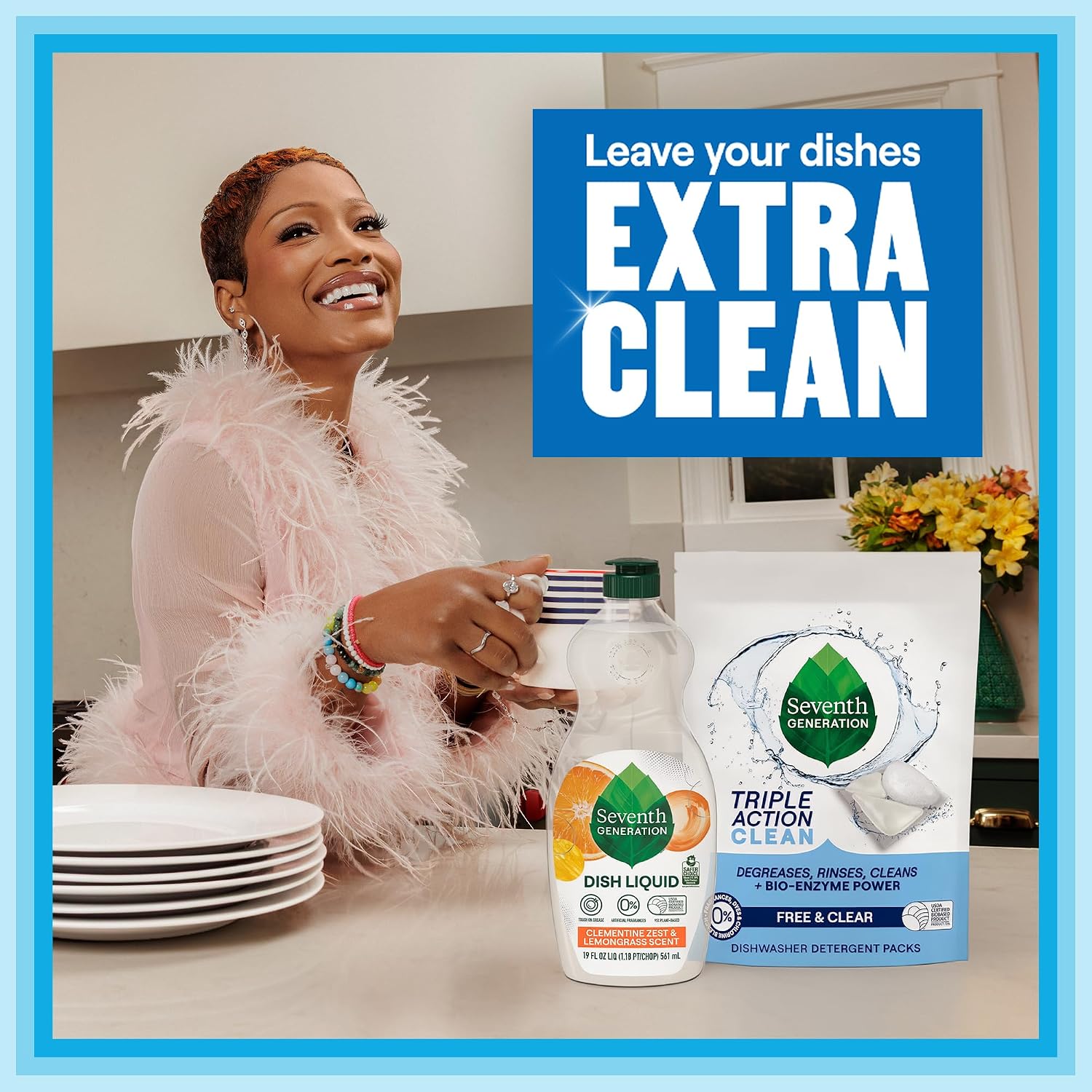
Seventh Generation’s fragrance-free formula is the category anchor for budget-conscious sensitive-skin buyers. It carries EPA Safer Choice certification — a program maintained by the U.S. Environmental Protection Agency, documented in the EPA Safer Choice Standard, that requires every ingredient in a finished product to meet safety standards for human health and the environment, not just the product as a whole. It also holds a general EWG rating, though not the higher “EWG Verified” tier.
The reviewer behavior that stands out: a meaningful share of Seventh Generation owners report using the same bottle as a hand soap refill. That multi-use pattern matters for cost-per-use. If a 25 oz bottle covers both dish duty and hand washing, the effective per-wash cost drops below what any single-product comparison chart would show.
On performance, the Good Housekeeping Institute’s dish soap reviews and testing note that plant-based surfactant systems — cleaning agents derived from coconut or corn rather than petroleum — can require slightly more volume per wash than conventional formulas on heavily greasy pans. Owners generally report Seventh Generation handles everyday loads well but that baked-on grease benefits from a soak first. That’s an honest tradeoff worth naming.
Best for: Eczema-prone skin, households wanting one fragrance-free product that doubles as hand soap, buyers who want a credentialed entry point without paying a premium.
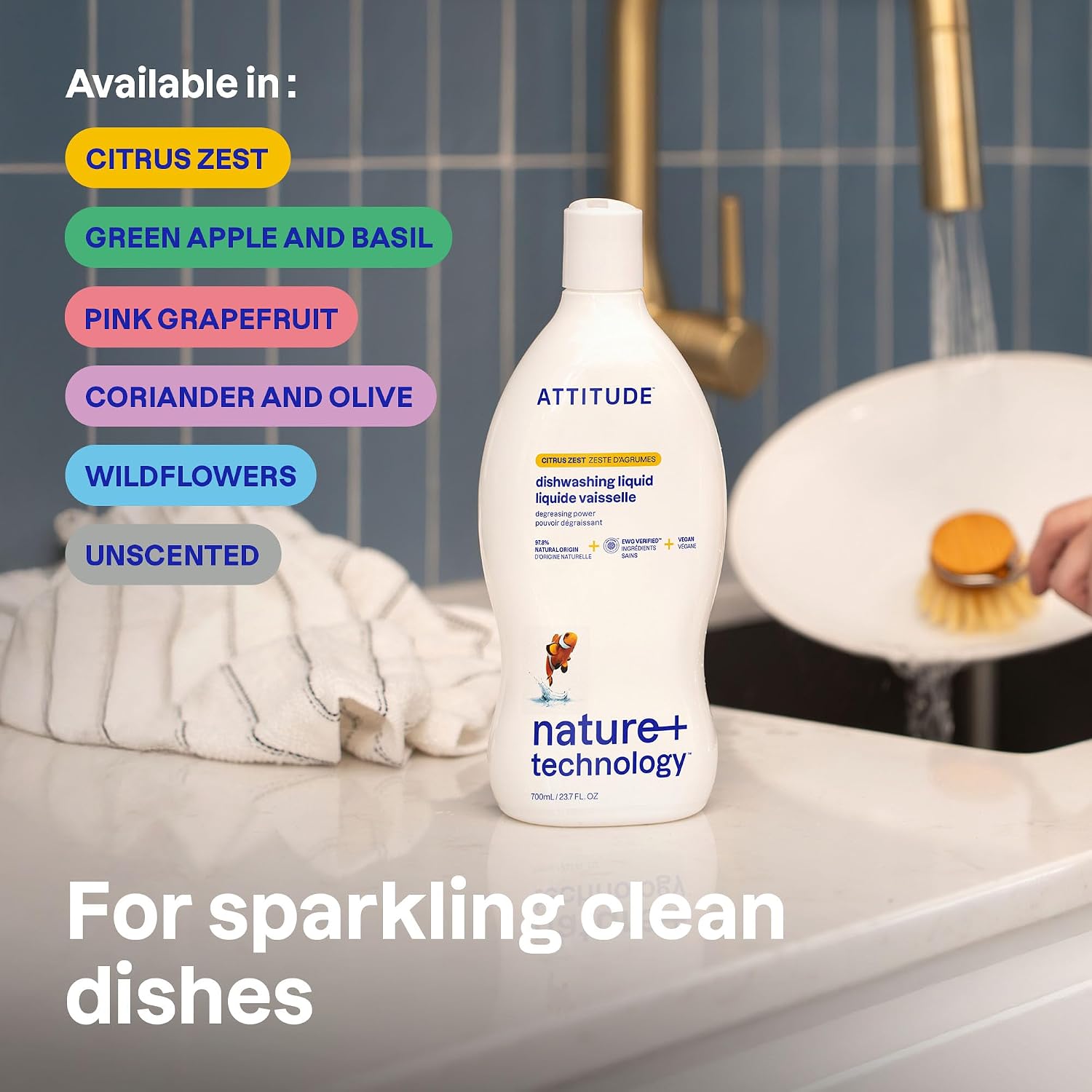
ATTITUDE
$7.19
In stock on Amazon
Check price on AmazonATTITUDE Fragrance-Free Dish Soap
ATTITUDE earns the EWG Verified designation — a meaningfully higher bar than a general EWG rating. According to the Environmental Working Group’s published EWG Verified Program Standards, EWG Verified products must disclose every ingredient including fragrance sub-components, meet restrictions on known or suspected toxicants, and pass manufacturing transparency requirements. It’s a substantial certification step above generic “clean” labeling.
ATTITUDE’s formula is plant- and mineral-based, available in a concentrated version that reduces plastic-per-wash, and skips dyes entirely. The fragrance-free variant sits cleanly in the true-fragrance-free camp with no essential oils or masking agents.
The cost-per-use case for concentrates: a 23.7 oz bottle at the recommended concentrated dilution yields more effective washes than a same-size conventional formula. Owners in long-run reviews note the formula lathers well even with a small amount — a behavioral signal that the product goes further than expected per application.
Best for: Buyers for whom EWG Verified certification is a non-negotiable shorthand for ingredient transparency. Also a strong pick for households with infants or immunocompromised members where documented ingredient safety has practical stakes beyond convenience.
No
$14.98
In stock on Amazon
Check price on AmazonGinger Lily Farms Botanicals
Ginger Lily Farms earns its most credible endorsement from a specific reviewer context: baby bottle washing. That’s a high-stakes use case. Owners who reach for something to wash infant feeding equipment are applying ingredient safety claims to one of the most consequential washing scenarios a household encounters — residue and chemical carry-over matter when the end user cannot voice a complaint.
The formula (fragrance-free variant) is concentrated and biodegradable. It does not carry EPA Safer Choice certification as of the time of this writing, but the published product specification documentation describes a plant-derived surfactant system that avoids dyes and synthetic fragrance.
On cost relative to Seventh Generation: Ginger Lily Farms is typically sold in larger concentrated volumes, which shifts the per-wash math favorably. The 32 oz concentrated format yields approximately 120–150 washes, compared to Seventh Generation’s roughly 60–80 washes from a 25 oz bottle at standard dilution — a measurable difference that compounds over a year of daily use.
Best for: Parents washing baby equipment, buyers who want a large-format concentrated purchase, households that prioritize real-world sensitive-skin endorsement from long-run owner experience.
No
$14.98
In stock on Amazon
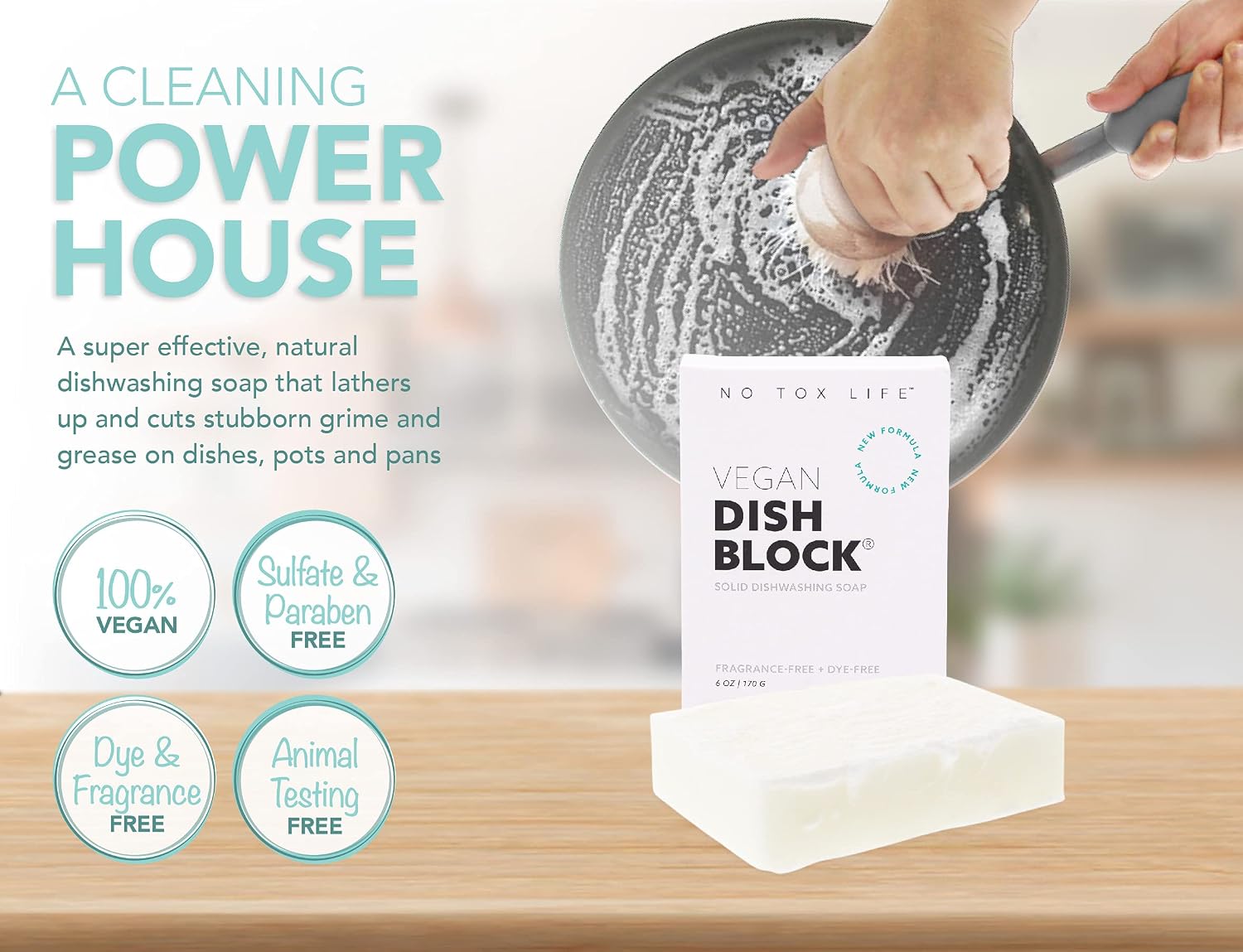
Check price on AmazonNo Tox Life Dish Block
The Dish Block is a solid bar dish soap — no bottle, minimal packaging, zero liquid formula. It’s the category outlier, and it generates the most instructive long-run review data of any product in this comparison.
One owner-reported data point that appears across multiple long-run reviews: a single bar lasting nearly two years of daily household use. The range in aggregated owner experience clusters around 6–12 months for typical daily dish washing, with the upper-range outliers almost uniformly attributable to one technique factor: cloth or sponge loading versus direct brush application.
The Dish Block requires loading a dishcloth or dish sponge by rubbing the bar, then washing with the cloth. Reviewers who skip this step and try to apply the bar directly to dishes report poor lather and carry-over residue in the ratings. Once users adopt the cloth technique, long-run reviews are consistently positive. That technique dependency is the single most important thing to know before purchasing.
For sensitive skin: the formula is vegan, palm-oil-free, fragrance-free, and uses simple surfactant chemistry with no dyes and minimal preservatives. The ingredient list is short and readable — a feature that appeals to buyers who want to evaluate formulas directly rather than rely on certification logos.
Best for: Zero-waste households, buyers willing to adopt a new washing technique in exchange for exceptional product longevity, anyone whose primary frustration is single-use plastic packaging.
ATTITUDE
$7.19
In stock on Amazon
Check price on AmazonCaldrea Dish Soap
Caldrea occupies the sensory-premium plant-based slot — exactly how its most-cited long-run reviewers describe it. This is a scent-positive formula, not a fragrance-free one. Caldrea uses essential-oil-based fragrance, which moves it out of the true-fragrance-free camp but keeps it away from synthetic fragrance chemistry.
As noted earlier, the National Eczema Association’s published ingredient guidance for sensitive skin flags fragrance of any origin — including essential oils — as a common skin sensitizer. Sensitive-skin buyers should weigh that before purchasing Caldrea, regardless of its plant-based sourcing.
One reviewer behavior worth documenting: multiple owners report diluting Caldrea in a foaming hand soap dispenser. Foaming dispensers require a thinner solution than standard hand soap — roughly a 1:4 to 1:6 ratio of soap to water. Reviewers who’ve made this conversion report it works well and extends a single bottle across both dish and hand-washing contexts. A 1:5 ratio is a reasonable starting point; adjust toward 1:4 if lather feels thin.
On cleaning performance, the Good Housekeeping Institute’s dish soap reviews and testing consistently find that premium plant-based formulas in this tier perform comparably to conventional soap on light-to-moderate grease loads, with slightly more effort required on baked-on residue — consistent with what Caldrea owners report.
Best for: Plant-based buyers who haven’t given up on scent, households that want a premium sensory experience at a moderate price point, buyers interested in extending one bottle across dish and hand-washing contexts with a foaming dispenser.
Seventh
$21.18
In stock on Amazon
Check price on AmazonBy the Numbers: Estimated Cost-Per-Wash Comparison
These figures are derived from published volume specs and standard dilution guidance. Actual yield varies with water hardness, load size, and technique.
| Product | Format | Approx. Washes per Unit | Est. Cost/Wash |
|---|---|---|---|
| Seventh Generation 25 oz | Liquid | ~60–80 | $0.08–0.12 |
| ATTITUDE 23.7 oz Concentrate | Liquid | ~90–110 | $0.07–0.10 |
| Ginger Lily Farms 32 oz Concentrate | Liquid | ~120–150 | $0.06–0.09 |
| No Tox Life Dish Block 9 oz | Solid bar | ~200–400+ (technique-dependent) | $0.02–0.05 |
| Caldrea 16 oz | Liquid | ~45–60 | $0.15–0.22 |
“Washes” = one standard sink load of household dishes. No Tox Life range reflects technique variance — cloth users report upper-range yields; direct-application users report lower.
Frequently Asked Questions
Is Seventh Generation dish soap gentle enough for eczema-prone hands? The National Eczema Association’s published ingredient guidance for sensitive skin identifies synthetic fragrance, dyes, and certain preservatives as primary triggers to avoid. Seventh Generation Free & Clear skips all three and carries EPA Safer Choice certification, documented in the EPA Safer Choice Standard published by the U.S. Environmental Protection Agency. Owners with documented eczema frequently cite it as their preferred formula. That said, individual sensitivities vary — even plant-derived surfactants can irritate severely compromised skin barriers. A patch test on the back of the hand before full adoption is the standard dermatologist-recommended approach.
What does EWG Verified mean for ATTITUDE, and is it different from a general EWG rating? Yes, meaningfully different. According to the Environmental Working Group’s published EWG Verified Program Standards, the Verified designation requires full ingredient disclosure including fragrance sub-components, restrictions on chemicals of concern, and manufacturing transparency — a more rigorous standard than a general EWG score or “EWG-rated” language. For skin-safety-focused buyers using EWG as a proxy for ingredient vetting, the Verified tier is a credible third-party bar.
Can Caldrea dish soap be used in a foaming hand soap dispenser? Yes, with dilution. A 1:5 ratio of Caldrea to water is a reasonable starting point for foaming dispensers. Shake gently after mixing. If lather feels thin, adjust toward 1:4. This is a documented reviewer behavior that meaningfully extends the cost-per-use math on a Caldrea purchase.
How long does a No Tox Life Dish Block last? Owner-reported data clusters around 6–12 months for typical daily household dish use, with upper-range outliers approaching two years. Variance is almost entirely technique-driven. Cloth and sponge users who load the bar by rubbing report dramatically longer yields than brush or direct-application users.
Is plant-based dish soap as effective as conventional soap on greasy pans? The Good Housekeeping Institute’s dish soap reviews and testing note that plant-based surfactant systems perform comparably to petroleum-derived formulas on light-to-moderate grease but may require more product or a longer soak on baked-on residue. The gap has narrowed as plant-based chemistry has improved, but it has not closed entirely for high-grease applications.
The Decision Rule
- If skin sensitivity is the primary driver and EPA environmental credentials matter → Seventh Generation Free & Clear, which carries EPA Safer Choice certification per the EPA Safer Choice Standard.
- If ingredient transparency and full-disclosure certification are non-negotiable → ATTITUDE Fragrance-Free, which holds EWG Verified status per the Environmental Working Group’s published EWG Verified Program Standards.
- If you’re washing baby equipment and want large-format concentrated value → Ginger Lily Farms in the 32 oz concentrated format.
- If cost-per-use over 12+ months is the primary optimization and you’ll commit to cloth technique → No Tox Life Dish Block.
- If you want plant-based chemistry without giving up scent, and you’d extend one bottle across dish and hand-washing → Caldrea with the foaming dispenser approach, keeping in mind that the National Eczema Association’s ingredient guidance flags even essential-oil fragrance as a potential sensitizer.
- If you’re evaluating these for client household use as an independent cleaning operator → The Seventh Generation and ATTITUDE pairing covers sensitive-skin documentation with verifiable certification credentials; Ginger Lily Farms concentrate delivers the lowest cost-per-wash at volume.
None of these products is a universal winner. The right answer depends on which tradeoff you can live with — and now you have the frame to make that call clearly.