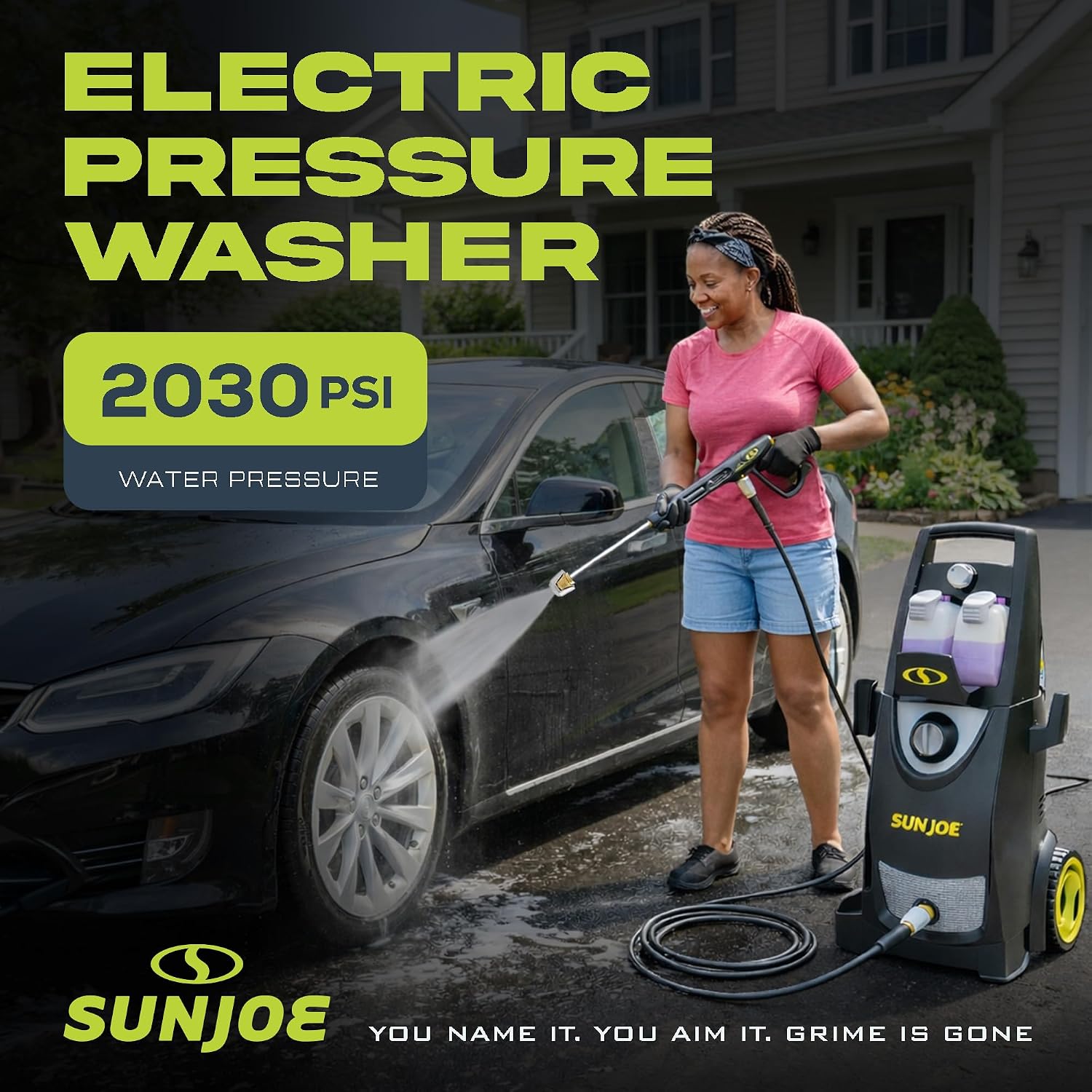
A pressure washer is exactly what it sounds like: a machine that forces water through a narrow nozzle at high speed to blast dirt, mildew, and grime off surfaces — driveways, siding, decks, vehicles — faster than scrubbing by hand ever could. Electric pressure washers plug into a standard household outlet and use a motor-driven pump to build that force, measured in PSI (pounds per square inch, how hard the water hits) and GPM (gallons per minute, how much water flows). Gas models use a combustion engine instead and generally reach higher pressures — but they’re louder, heavier, require more maintenance, and carry safety rules that electric units don’t. If you’re a first-time buyer trying to decide whether an electric unit can handle your driveway, your car, or your deck, the short answer is: yes, for most residential jobs, a quality 1800–2300 PSI electric washer is enough. The longer answer — covering which models hold up, where buyers get tripped up, and how to avoid the frustrations that show up in owner reviews — is what this guide is for.
The PSI and GPM Numbers That Actually Matter (and the Ones That Don’t)
Manufacturers love to lead with peak PSI because big numbers sell. What the spec sheet often buries is that peak PSI is measured under zero flow — the moment before you pull the trigger. Real cleaning power lives in cleaning units (CU), which is simply PSI × GPM. A washer rated at 2300 PSI and 1.2 GPM produces 2,760 CU. A unit rated at 1800 PSI and 1.6 GPM produces 2,880 CU — more actual cleaning muscle despite the lower headline pressure number.
By the numbers — cleaning unit benchmarks:
- Under 2,000 CU: Light duty. Good for vehicles, lawn furniture, trash cans.
- 2,000–3,000 CU: Medium duty. Handles most residential concrete, deck wood, siding.
- 3,000–4,500 CU: Heavy duty. Paint prep, stubborn oil stains, large commercial surfaces.
- Above 4,500 CU: Typically requires gas; beyond most residential electric units.
Consumer Reports’ pressure washer buying guide consistently flags the PSI-vs-CU confusion as the top reason buyers feel disappointed after purchase. Wirecutter’s pressure washer roundup (New York Times, 2025 edition) echoes this: their recommended electric picks are chosen partly because their GPM ratings support sustained cleaning rather than just impressive peak numbers on the box.
What this means practically: a Greenworks 2000 PSI unit with a solid GPM rating can outclean a cheaper 2300 PSI unit with a restricted flow path. Read both numbers. Then multiply.
What Owner Reviews Keep Flagging — Before You Unbox
Across aggregated owner feedback on Sun Joe, Westinghouse, and Greenworks electric models, three friction points come up with notable consistency. None of them are dealbreakers — but all three are surprises that cost people time on their first use.
Assembly Instructions
Sun Joe models are flagged repeatedly in owner reviews for assembly documentation that is either unclear or incomplete — particularly around hose connection sequencing and O-ring placement. The actual assembly isn’t mechanically difficult, but the instruction booklet apparently assumes more baseline familiarity than most first-time buyers have. Owners report that supplementing the printed manual with a model-specific walkthrough video resolves the confusion quickly, so plan for 30–45 minutes on setup day rather than 10.
Hose Stiffness
High-pressure hoses need to be rated for the pressure they carry, which means they’re reinforced — and reinforcement adds stiffness. On most 25-foot hoses included with entry-level electric washers, owners consistently describe the hose as “fighting back” when maneuvering around a vehicle or trying to work tight corners. The practical fix: let the hose warm up by running water through it for 60 seconds before you start, and store it loosely coiled (more on storage below). Owners who upgraded to a 50-foot aftermarket hose often report that the additional length reduces the tension problem because there’s more slack to work with — though longer hoses can produce a small pressure drop.
Soap Tank Capacity
Most electric pressure washers include a small onboard detergent reservoir — typically 20 to 50 ounces. On a two-car driveway or a full deck cleaning job, owners consistently report needing to refill the soap tank at least once, sometimes twice. The surprise isn’t the refill itself; it’s that buyers don’t plan for it and run out mid-pass. Good Housekeeping’s pressure washer reviews note that Westinghouse ePX models earn specific praise for their detachable soap tank design, which makes mid-job refills faster and less messy than designs that require tilting or unscrewing components. The ePX soap system is also noted for working cleanly with the low-pressure soap nozzle (the black nozzle in most five-nozzle sets) — you switch to that nozzle to draw detergent, then swap back to a higher-pressure nozzle to rinse.
Electric vs. Gas: The Real Decision Frame
The gas vs. electric question resolves quickly once you’re specific about the job. The pattern across owner reviews is consistent enough to treat as a decision rule:
Owners who previously rented gas washers annually for car washing and light concrete cleaning report that switching to an electric unit handled those jobs without meaningful compromise — and eliminated the rental cost, the transport hassle, and the noise. That’s the core use case where electric wins on all dimensions.
Owners who chose gas models — particularly units like the WPX3400 class — describe their decision explicitly: paint stripping, heavy oil stains embedded in aged concrete, or commercial-volume work where the job takes multiple hours. Those applications genuinely need the higher CU output that gas provides.
If your jobs are: car washing, composite or wood decking, vinyl siding, light-to-moderate concrete (driveway grime, not decade-old oil stains), trash cans, lawn furniture → electric is enough, and the tradeoffs favor it.
If your jobs are: paint prep, stripping sealers, heavy concrete restoration, or sustained professional use → gas is worth the added complexity.
One safety-critical fact belongs in this section regardless of which direction you go: per PWMA (Pressure Washer Manufacturers’ Association) operator safety guidelines, running a gas pressure washer pump without the spray wand engaged for more than approximately one minute causes the pump to recirculate water, which heats rapidly and can damage pump seals or cause failure. This is not well-labeled on most gas units and does not appear in many quick-start guides. If you’re demoing a gas unit, testing it, or pausing mid-job, either engage the trigger periodically or shut the engine down.
Compact Storage: Solving the Garage-Space Problem
Westinghouse ePX models earn disproportionate praise in owner reviews specifically for storage design — a detail that sounds minor until you’re the person trying to fit a pressure washer into a single-car garage already holding a lawnmower and seasonal gear. Owners describe the detachable hose and accessory organization on the ePX as solving a real space problem rather than just looking cleaner in product photos.
For any electric pressure washer, the hose is the storage headache. Recommendations from owners who’ve worked through this:
- Never store a kinked hose. Kinks create pressure weak points that fail mid-job.
- Loose coils beat tight wraps. A 25-foot hose stored in large, relaxed loops holds its shape better over seasons than one cinched tightly to the unit.
- Drain before storing. Water left in the pump over winter (in freeze-prone climates) can crack the pump housing. Most electric units have a simple drainage step in the manual — it takes 90 seconds and prevents an expensive repair.
- Wall-mount hooks beat floor storage. Owners consistently report that floor-stored hoses become trip hazards and develop kinks from being walked on. A basic hose hook rated for the hose diameter costs under $15 and extends hose life measurably.
Frequently Asked Questions
Is a 2000–2300 PSI electric pressure washer enough for cleaning a concrete driveway?
For routine residential driveway maintenance — general grime, mildew, dirt accumulation — yes. Consumer Reports’ buying guide and Wirecutter’s electric washer picks both confirm that 2000–2300 PSI electric models handle standard residential concrete effectively. One Greenworks owner reports eight years of reliable service from a 2000 PSI unit used for exactly this purpose — a longevity data point worth noting for buyers worried about durability. The exception: old oil stains or oxidized concrete that’s been neglected for years may need repeated passes or a dedicated concrete-cleaning attachment (a rotating surface cleaner nozzle), which most electric models support.
What happens if you run a gas pressure washer pump without the spray wand engaged for more than a minute?
The pump recirculates water internally, which builds heat rapidly. After roughly 60 seconds without flow, pump temperatures can reach levels that damage seals, O-rings, and internal components — sometimes causing outright pump failure. Per PWMA operator safety guidelines, never let a running gas unit idle with the trigger released for extended periods. Either keep the trigger pulled periodically or shut down the engine. This rule does not apply the same way to electric units, which cut power to the pump when trigger pressure drops, but it’s the single most safety-consequential detail buried in gas washer ownership.
How do the soap tanks on Westinghouse electric models work with the nozzle system?
Westinghouse ePX electric models use a detachable soap bottle that connects to the machine’s low-pressure draw system. Detergent only flows when you’re using the low-pressure black nozzle — the soap won’t dispense through high-pressure nozzles. The correct sequence: attach and fill the soap bottle, switch to the black soap nozzle, apply detergent to the surface, then swap to a higher-pressure nozzle (typically the 25° or 40° nozzle) for the rinse pass. Reviewers consistently note that the detachable design makes refilling mid-job significantly faster than integrated fixed-tank designs.
Will an electric pressure washer be loud enough to disturb neighbors?
Electric pressure washers typically operate in the 75–85 dB range at the operator position — roughly comparable to a lawnmower at distance. They are substantially quieter than gas models, which commonly reach 90–95 dB. For most residential neighborhoods, an electric washer used during daytime hours won’t create noise conflicts. Good Housekeeping’s reviews note the noise reduction as a meaningful practical advantage for urban or suburban buyers with close neighbors.
How do you store a compact electric pressure washer so the hose doesn’t become a problem?
Store the hose in large, loose coils — not tight wraps. Drain the hose and pump before long-term storage (especially in freezing climates). If your unit has a hose reel or wrap points, use them loosely. Wall-mount hooks work well for hose-only storage. And keep the hose off the floor: kinks from foot traffic are the most common cause of early hose failure in owner reports.
Is an electric pressure washer good enough to replace renting a gas unit for annual driveway cleaning?
For most homeowners, yes. Owners who previously rented gas units annually for car washing and light concrete cleaning report that electric models handled those jobs without meaningful compromise — and eliminated the cost and hassle of rental. The economics favor ownership quickly: a quality electric unit in the $150–$300 range pays back against a single annual rental within one to two seasons. The one scenario where gas rental still makes sense: heavy concrete restoration, paint stripping, or any job that genuinely needs sustained output above 3,500 CU. For everything else, the electric case is strong.