
If you’ve been shopping cordless stick vacuums — the lightweight, battery-powered vacuums that stand upright without a cord — you already know the mid-range ($150–$350) is crowded and confusing. Every box promises “powerful suction” and “long runtime,” and every set of specs lists a number you can’t easily compare to a competing number. This article cuts through that. We read the owner reviews, compared the published specs, and synthesized what actual buyers say after months of use — so you get a decision frame, not just a feature list. If you’re choosing between the Shark PowerPro, a Levoit cordless, or the Tikom V500, here’s what the evidence actually shows.
| EDITOR'S PICKShark PowerPro Plus Cordless St… | Mid-tierLEVOIT Cordless Vacuum Cleaner | Budget pickTikom V500 Cordless Vacuum Clea… | |
|---|---|---|---|
| Runtime | 50 min | 50 min | — |
| HEPA filter | ✓ | — | — |
| Suction power | — | — | 450W |
| Wall dock | — | — | ✓ |
| Display | — | — | LED touch |
| Price | $199.99 | $129.99 | $79.96 |
| See on Amazon → | See on Amazon → | See on Amazon → |
What Owners Are Really Saying: The Pattern Across All Three
Before diving into each model, it’s worth naming the single clearest signal across aggregated reviews: floor type is the biggest predictor of satisfaction in this price tier. Owners who vacuum mostly hard floors — hardwood, tile, LVP (luxury vinyl plank) — report significantly higher satisfaction across all three models than owners with substantial wall-to-wall carpet. That’s not a knock on any one vacuum; it’s a category reality. Mid-range cordless suction motors simply can’t match corded uprights or high-end cordless units on deep-pile carpet. If your home is 70% carpet or more, that’s the most important sentence in this article.
Wirecutter’s guide “The Best Cordless Stick Vacuums” (updated 2025) reinforces this point directly, noting that no cordless unit in the sub-$300 tier consistently matched corded uprights on medium-to-high pile carpet in their testing. Consumer Reports’ “Cordless Vacuum Ratings and Reliability Data” (2025) echoes the finding, identifying carpet-agitation depth as the category’s most persistent performance gap regardless of brand.
Now, model by model.
Shark PowerPro: The Maintenance-Friendly Pick
Who it’s built for and what owners love
The most consistent theme in Shark PowerPro reviews isn’t suction — it’s ease of maintenance. Multiple owners on aggregated retail review platforms specifically cite the self-cleaning brush roll and the straightforward bin-emptying mechanism as the reason they chose it over competing models after doing side-by-side research. That’s a meaningful data point: these aren’t buyers who stumbled into the purchase; they compared, chose, and then confirmed their reasoning post-purchase.
The Good Housekeeping Institute’s “Best Cordless Vacuums” evaluation roundup (2025) notes that Shark’s brush roll self-cleaning technology addresses one of the most common mid-range pain points: hair and fiber wrap requiring manual removal every few uses. Owners with pets or long hair consistently flag this as a significant quality-of-life difference compared to units that require manual de-tangling every week or two.
The FloorDetect trade-off and the rug problem
The Shark PowerPro’s FloorDetect technology automatically adjusts suction and brush roll speed when it senses a transition from hard floor to carpet. In day-to-day use, owners report this works well for area rugs over hard floor — the vacuum transitions smoothly and picks up debris without manual adjustment. However — and this is the frustration that shows up repeatedly — the suction on lightweight rugs is strong enough to lift the rug itself off the floor. Multiple reviewers describe having to hold down bath mats or lightweight area rugs with one foot while vacuuming. That’s not a defect; it’s physics. The FloorDetect ramps up suction when it senses carpet, and lightweight rugs have nothing anchoring them. If you own a home with several thin accent rugs, factor this in as a real daily annoyance, not a theoretical one.
On genuine wall-to-wall carpet, the automatic adjustment performs reasonably well for surface debris but doesn’t provide the deep-fiber agitation that a dedicated carpet vacuum would. Owners with medium-pile carpet describe it as “good enough for daily maintenance between deeper cleans.”
The decision frame for Shark PowerPro
Best for: Hard floors and medium-pile carpet in homes with pets or long-haired occupants who want to avoid constant brush roll maintenance.
Watch out for: Lightweight area rugs — the FloorDetect suction increase will lift them. Daily workflow annoyance is real and reported consistently.
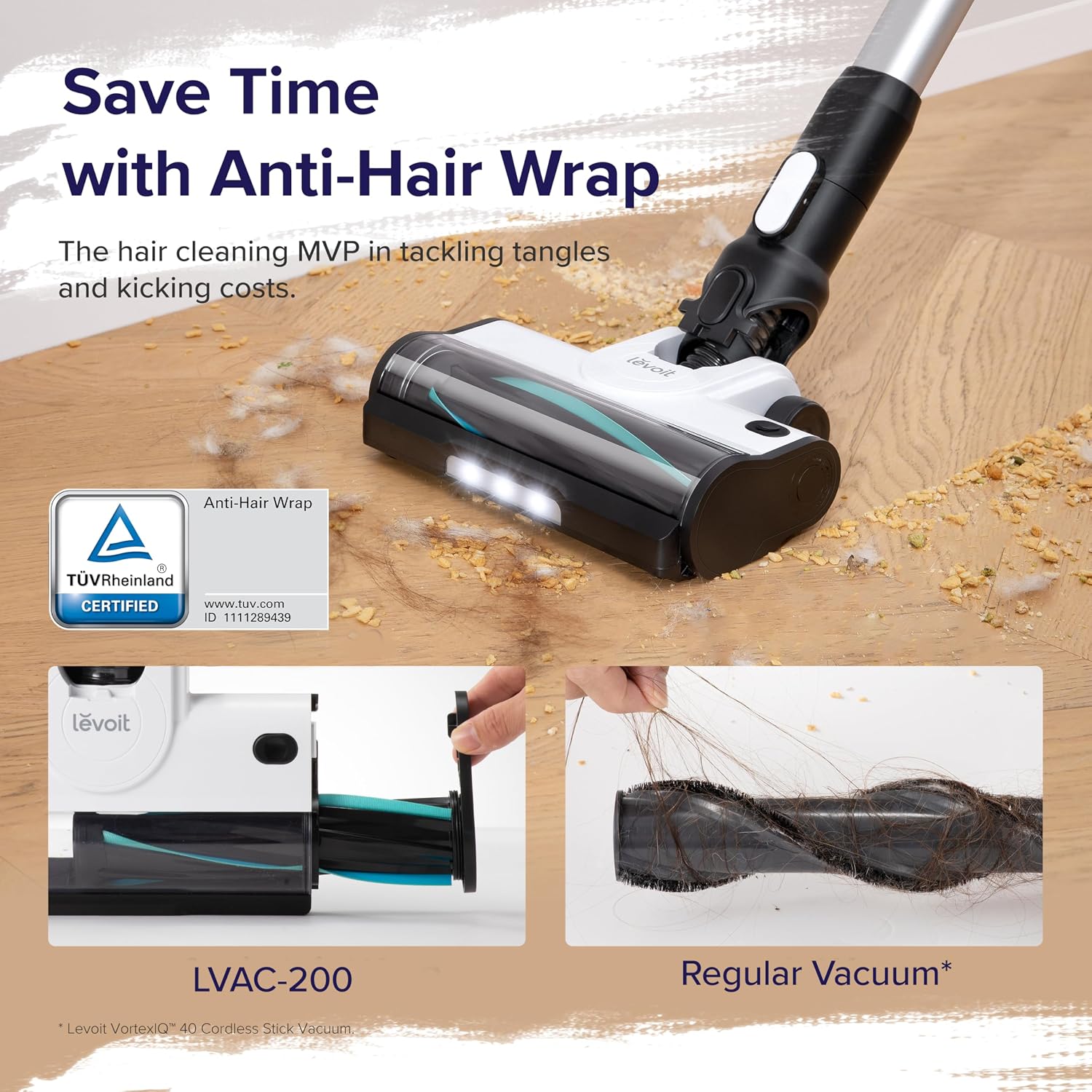
LEVOIT
$129.99
In stock on Amazon
Check price on AmazonLevoit Cordless: The Runtime Argument
Who it’s built for and what owners love
Levoit cordless vacuum owners anchor their praise almost exclusively around runtime and whole-home coverage on a single charge. The pattern in long-run reviews is consistent: buyers who chose Levoit frequently frame it as a deliberate value decision — they researched competing options, calculated the price-per-feature gap, and concluded that the runtime advantage justified the purchase over pricier alternatives.
Apartment Therapy’s “How to Choose a Cordless Vacuum for Small Spaces” (2024) notes that runtime matters most in homes above 1,200 square feet, where a single vacuuming session might otherwise require a mid-session recharge — a workflow interruption that owners report as more frustrating in practice than it sounds in theory. The Levoit’s eco-mode runtime positions it well for that use case.
Carpet performance: the honest picture
On hard floors, Levoit owners report strong satisfaction. On carpet, the picture is more mixed. Owners with low-pile or Berber carpet describe acceptable performance for routine passes. Owners with medium-to-high pile carpet — especially those who switched from a corded upright — consistently note that the Levoit doesn’t pull embedded debris with the same authority.
Consumer Reports’ “Cordless Vacuum Ratings and Reliability Data” (2025) identifies this suction-wattage tier as the category’s known weak point for carpet performance regardless of brand. The practical takeaway: if your home is primarily hard floors with some low-pile carpet, Levoit’s runtime advantage may be the deciding factor. If carpet performance is mission-critical, neither Levoit nor any mid-range cordless is your best tool.
The decision frame for Levoit cordless
Best for: Larger homes (1,200+ sq ft) with primarily hard floors where whole-home coverage on a single charge is the priority.
Watch out for: Medium-to-high pile carpet performance. Owners who prioritize carpet suction depth consistently report disappointment relative to corded uprights.
LEVOIT
$129.99
In stock on Amazon
Check price on AmazonTikom V500: The Budget Case With Real Trade-offs
What the spec sheet says — and what owners confirm
The Tikom V500 is marketed at approximately 45,000 Pa of suction (Pa = Pascals, a unit of air pressure used to measure suction force at the nozzle). To put that in context: most mid-range cordless units are rated 20,000–28,000 Pa in comparable manufacturer specifications. The 45,000 Pa figure is peak suction, typically measured in a sealed condition at the nozzle — not how you vacuum a floor in real use. Owners report that real-world performance on hard floors is strong relative to the price point, and several long-run reviewers describe surface-debris pickup results they find comparable to older entry-level cordless models on hard floors specifically.
On carpet, the gap widens. The V500 doesn’t have the motor engineering headroom of premium-tier cordless units, and owners who push it on carpet consistently note the difference in embedded-debris removal.
The LED battery display: a genuine differentiator
The Tikom V500’s battery percentage LED display is one of its most consistently praised features — and that praise is more meaningful than it might seem. Owners of competing budget cordless models that use only a color-coded indicator light repeatedly report the same frustration: you can’t tell whether you have 20 minutes left or 4 minutes left until the vacuum dies mid-room. A precise percentage display eliminates that guesswork entirely. For buyers weighing multiple budget units, this feature is worth real consideration.
The bin-emptying problem
Here’s where budget construction shows. Long-run reviews on the Tikom V500 and similar units consistently flag dustbin design as the point where cost-cutting becomes a real daily frustration. The bin-emptying mechanism on these units often requires more manual contact with collected debris than higher-end designs, and the tolerances on the bin release can loosen over months of regular use. If you’re buying this vacuum as a primary cleaner for daily use, read the bin-emptying reviews carefully before committing — especially if you have allergies or asthma and want minimal debris contact during emptying.
The decision frame for Tikom V500
Best for: Budget-constrained buyers with primarily hard floors who want precise battery-level feedback and can tolerate a less refined bin-emptying experience.
Watch out for: Bin mechanism durability over time and carpet performance gaps versus mid-range units. Go in eyes-open.
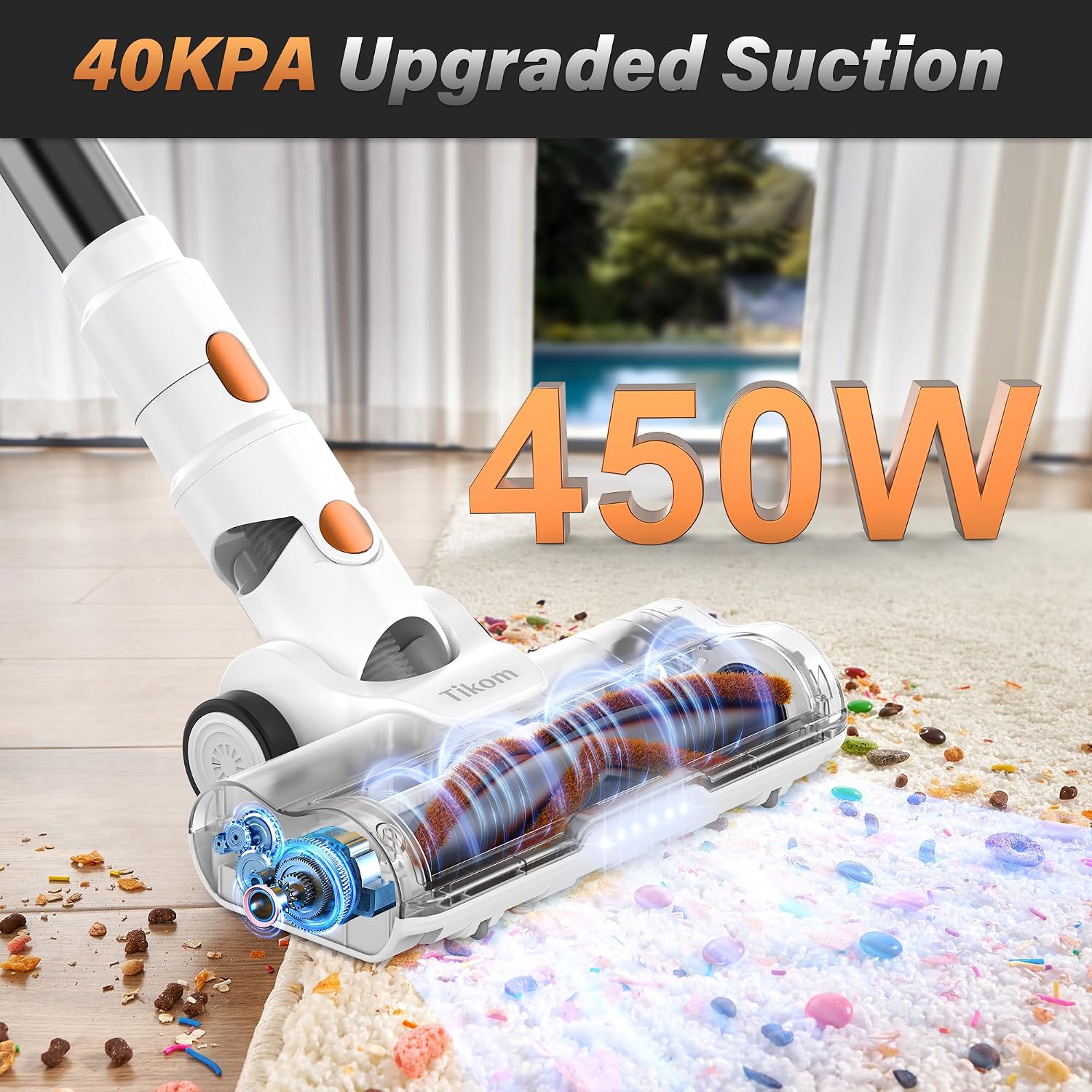
Tikom
$79.96
In stock on Amazon
Check price on AmazonBy the Numbers
| Model | Rated Suction | Runtime (high mode) | Runtime (eco mode) | Key differentiator | Tier |
|---|---|---|---|---|---|
| Shark PowerPro | ~25,000 Pa (est.) | ~15–20 min | ~40–60 min | Self-cleaning brush roll, FloorDetect | LEVOIT — $129.99 |
| Levoit Cordless | ~22,000 Pa (est.) | ~12–18 min | ~45–60 min | Whole-home runtime, value positioning | LEVOIT — $129.99 |
| Tikom V500 | 45,000 Pa (peak, mfr.) | ~35 min | ~55 min | Battery % LED, hard floor value | Tikom — $79.96 |
Note: Pa figures for Shark and Levoit are estimated from comparable models referenced in Wirecutter’s “The Best Cordless Stick Vacuums” (2025) and Good Housekeeping Institute’s 2025 evaluation roundup; manufacturer-rated peak Pa figures can be misleading across brands. Runtime figures reflect aggregated owner reports, not controlled lab conditions.
The Runtime Reality: High Mode vs. Rated Maximum
One of the most reliable frustrations in cordless vacuum ownership — across all brands — is the gap between rated maximum runtime and actual runtime on high suction mode. The rated maximum almost always reflects the lowest power setting. On high mode, owners across all three models report roughly one-third to one-half the rated runtime. A vacuum rated at 60 minutes may deliver 15–20 minutes on high. This isn’t a defect or false advertising; it’s physics — higher suction draws more power from the battery faster. But buyers who don’t read past the headline runtime figure consistently report feeling misled. When you see a runtime figure on a box or product page, mentally divide it by two to three for high-mode use.
Frequently Asked Questions
Does the Shark PowerPro’s suction actually pick up lightweight rugs off the floor? Yes — and that’s the problem. Multiple owners report that the PowerPro’s FloorDetect system increases suction when it senses carpet, which is strong enough to lift thin bath mats and lightweight area rugs. You’ll likely need to hold them down with one foot while vacuuming. On heavier area rugs or wall-to-wall carpet, this isn’t an issue.
How does the Levoit cordless perform on carpet compared to hard floors? On hard floors, Levoit owners are consistently satisfied. On carpet — especially medium to high pile — performance is noticeably weaker. Consumer Reports’ 2025 cordless vacuum reliability data identifies this as a category-wide limitation at this suction tier. The Levoit is best suited to homes where hard floors are the primary surface.
What does FloorDetect technology actually do day to day? It uses sensors to detect transitions from hard floor to carpet and automatically increases suction and adjusts brush roll speed. In practice, owners describe smooth transitions without manual mode switching. The daily annoyance for some owners is the rug-lifting side effect on lightweight rugs described above.
How does runtime on high suction mode compare to the rated maximum? Expect roughly one-third to one-half the rated maximum runtime when running on high. A 60-minute rated vacuum typically delivers 15–25 minutes on high mode. This is consistent across all three models and is a category-wide reality, not a brand-specific issue.
Is the Tikom V500’s 45,000 Pa figure comparable to other brands’ ratings? Not directly. The 45,000 Pa figure is peak suction measured at the nozzle in sealed conditions. Dyson and other premium brands often publish suction in air watts (AW), a different measurement that accounts for airflow. Don’t compare Pa figures across brands as if they’re equivalent — use them only as rough within-brand guidance.
What should I know about dustbin design before buying a budget cordless vacuum? Budget cordless bins (typically under $200) often have less refined release mechanisms and require more debris contact during emptying than mid-range or premium models. Long-run reviewers on the Tikom V500 flag this as a real frustration after several months of daily use. If mess-free emptying is important — especially for allergy sufferers — look for one-touch hygienic bin release, a feature more common in the $250+ tier.
The Decision Rule
-
Mostly hard floors, own pets or have long hair, hate brush roll maintenance → Shark PowerPro. The self-cleaning brush roll is a genuine differentiator, and the FloorDetect works well if you don’t own a collection of lightweight accent rugs.
-
Larger home, primarily hard floors, value runtime over premium features → Levoit cordless. Whole-home coverage on a single charge is the strongest practical argument for this model among budget-conscious buyers with open floor plans.
-
Budget is the primary constraint, hard floors are the primary surface, and you want to know your exact battery level → Tikom V500. Go in eyes-open on bin design and carpet limitations, and you’ll get solid hard-floor performance for the price.
None of these vacuums are the right tool for a home that’s majority medium-to-high pile carpet. For that use case, you’re looking at a corded upright or a premium cordless investment in the $500+ tier — and that’s a different article.