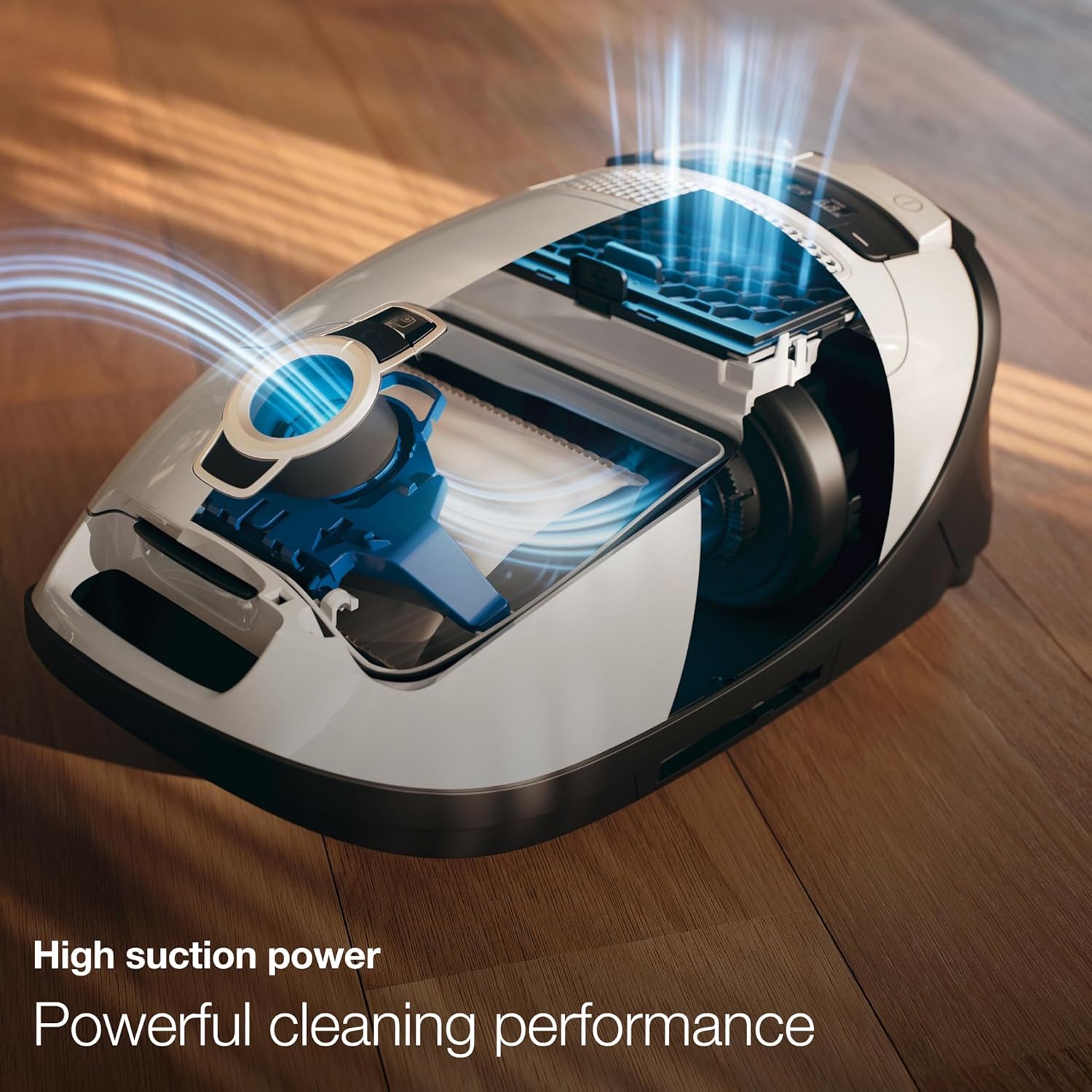
A canister vacuum is a two-piece cleaning system: the motor and dustbin ride in a rolling canister (the “can”) that you pull behind you on wheels, while a separate wand and floor head connect to it via a flexible hose. That design gives you a longer reach and usually a quieter motor than an upright, which is why canister vacuums dominate in European homes and among cleaning professionals who work hard floors all day. The question this article answers is simple: which canister vacuums still earn their keep after year one, two, or three — when the novelty has worn off and real durability shows itself? We read through hundreds of long-term owner accounts, cross-referenced findings with Consumer Reports’ canister reliability data and Wirecutter’s category analysis, and built the decision frame below. You’ll get the honest trade-offs at each price tier, the math on total cost of ownership, and clear “if X, then Y” rules so you can stop second-guessing and move forward.
| EDITOR'S PICKMiele Classic C1 Turbo Team Bag… | Mid-tierKenmore 81214 200 Series Pet Fr… | Budget pickBissell Zing Lightweight | |
|---|---|---|---|
| Filtration | — | HEPA | — |
| Motor System | — | 2 Motor | — |
| Cleaning Tools | — | 3 | — |
| Pet Friendly | — | ✓ | — |
| Price | $369.99 | $194.99 | $89.99 |
| See on Amazon → | See on Amazon → | See on Amazon → |
What Long-Term Owners Actually Report (And Why That Matters More Than First-Week Reviews)
Most vacuum reviews are written within the first month. The owner is still impressed by the box, the suction feels strong, and nothing has broken yet. That’s why the Miele Classic C1 review dataset stands out in a way we rarely see: a meaningful share of its owners explicitly say they waited — months, sometimes years — before posting, because they wanted to report on durability rather than first impressions. One three-year owner of the Pure Suction model opens their review by stating that intent directly. That’s not a marketing claim; that’s a buyer choosing to be useful to the next buyer.
This review pattern tells you something structural about who buys the Miele Classic C1 and what they expect from it. These are not impulse purchasers. They’re people who researched, committed capital, and then quietly watched the machine perform. What they report, consistently, is that it does.
The most instructive single data point in the long-term dataset: an 8.5-year professional cleaner who had previously bought a new Shark vacuum every single year because each one wore out, tried the Miele Turbo Team, and describes it as the first vacuum she has recommended without reservation. That’s not a casual endorsement. That’s someone doing cost-per-unit math in real time and arriving at a conclusion.
Good Housekeeping’s long-term vacuum assessments and Wirecutter’s multi-year category tracking both support the pattern: bagged canisters with sealed filtration systems — the design Miele uses — tend to maintain suction more consistently over time than bagless designs, because there’s no filter media that progressively clogs and degrades performance.
The Miele Classic C1: Where It Earns Its Price and Where It Doesn’t
The hard-floor story is real. The Pure Suction model — no motorized brush roll, just suction through a smooth floor head — is legitimately excellent on hardwood, tile, LVP (luxury vinyl plank), and laminate. Owners report no meaningful suction loss over two and three years of regular use. The motor is German-manufactured, the build quality is industrial relative to the price class, and the bag system (using Miele’s AirClean filtration bags) keeps the exhaust air remarkably clean.
The carpet limitation is real too, and non-negotiable. This is the single most important thing to understand before purchase: the Pure Suction model is not a carpet vacuum. One long-term owner is emphatic about this — they own a separate Miele Powerline C3 for carpet and use the Classic C1 exclusively on hard floors. If your home is majority carpet, the Pure Suction model will underperform and you’ll resent the purchase. The Turbo Team variant adds a turbine-driven brush roll (spun by airflow, not a separate motor) that handles low-to-medium pile carpet adequately, but it is still not a deep-carpet powerhouse.
The bag cost math. Miele’s AirClean bags run roughly $4–$6 per bag at standard retail; a pack of four or five bags typically costs $20–$28. Usage frequency determines annual cost:
By the numbers — annual bag cost estimate (Classic C1 Pure Suction, average household): Light use (1–2 rooms, weekly): ~4–6 bags/year → ~$20–$36/year Moderate use (whole-home hard floors, twice weekly): ~8–12 bags/year → $40–$70/year Heavy/professional use: 12–18 bags/year → $60–$100/year
That’s a real carrying cost. It’s also the mechanism that keeps suction consistent — a nearly full Miele bag still flows air better than a dirty foam filter in a bagless machine. Factor it into your total cost of ownership rather than treating the vacuum’s purchase price as the whole picture.
The Kenmore 600 Series: A Genuinely Conflicted Record
This is the section where we resist the temptation to pick a side, because the owner data genuinely doesn’t support a clean verdict.
The case for the Kenmore 600 Series is real. A household managing four dogs and six cats — a legitimate stress test for any filtration and suction system — rates it highly at the two-month mark. Suction is strong, the price-to-performance ratio at initial purchase is favorable, and for many households it does exactly what it promises.
The case against is also documented. A separate owner in the same product line reports progressive suction failure and multiple repair visits before the three-year mark. The machine worked, then degraded, then required intervention, then degraded again. This is not an isolated complaint; the pattern appears across the Kenmore brand’s long-term owner data with enough frequency that Consumer Reports’ reliability ratings for the brand reflect the variability.
The Kenmore 600 Series rear-wheel design is a specific mechanical frustration that owners mention repeatedly: the large rear wheels sit wide and catch on furniture legs, chair bases, and doorframes when you’re pulling the canister around a room. It’s not a dealbreaker in open spaces, but in a furnished apartment or a home with a lot of furniture traffic, it adds friction — literal and psychological — to every cleaning session. It’s the kind of thing that doesn’t show up in a first-week review because you haven’t yet learned to hate it.
The decision frame for Kenmore 600 Series: if your cleaning environment is relatively open, your budget is $150–$250, and you’re comfortable with the possibility of needing service before year three, it can be a workable choice. If you’re furnishing a tightly arranged space or you need reliability certainty over a multi-year horizon, the variability in the long-term record is a real risk to price into your decision.
The Budget Canister Surprise: Bissell Zing at Year Six
The finding that genuinely caught us off guard in the research: a heavy-shed-dog owner reports that their Bissell Zing — a bagged canister that retails in the $60–$80 range — is still performing at year six. Six years. With a heavy-shedding dog.
That’s not the story you expect from a budget canister. The Zing is simple: minimal electronics, basic suction, no motorized brush roll, a straightforward bag system. Its durability advantage may come precisely from its simplicity — fewer components means fewer things to fail. The same principle that makes a 1990s Honda Civic reliable at 200,000 miles applies here.
What it can’t do: the Bissell Zing is not a carpet machine, struggles with debris that’s worked into pile, and lacks the filtration sophistication of the Miele bag-plus-sealed-system design. If you have allergy concerns, the exhaust air quality is not comparable. But for hard floors, light rugs, and pet hair on smooth surfaces? The durability evidence suggests it punches well above its price.
Wirecutter’s budget vacuum coverage and Good Housekeeping’s value-tier assessments both acknowledge that simple bagged canister designs have historically outperformed their price point on longevity, even when they lose in head-to-head suction tests against more expensive competitors.
The Cost-Per-Year Math: New Shark Every Year vs. One Miele
This is the calculation the professional cleaner data makes vivid. Here’s the framework:
A mid-range Shark upright runs roughly $150–$250 at current (May 2026) pricing. If you replace it annually due to wear — as the 8.5-year professional cleaner did — you’re spending $150–$250 per year, every year, indefinitely. At eight years, that’s $1,200–$2,000 total outlay.
A Miele Classic C1 Turbo Team runs roughly $400–$500 at retail. Add $60–$100/year in bags. At eight years, all-in cost: $880–$1,300.
The Miele is cheaper over eight years, even before accounting for the time and friction cost of sourcing, breaking in, and disposing of a new machine every twelve months. For a professional cleaner who bills by the job, that friction has real dollar value.
For a homeowner who only vacuums once a week and keeps machines longer, the math still favors the Miele at the five-year mark. The break-even against a Kenmore 600 Series (roughly $200–$250) lands closer to three years, depending on bag costs and whether the Kenmore avoids service events.
Frequently Asked Questions
Is the Miele Classic C1 Pure Suction model good enough for carpeted rooms or only hard floors? It is not positioned as a carpet vacuum, and long-term owners are clear that it shouldn’t be used as one. One owner explicitly states they keep a separate Miele Powerline C3 for carpet. On low-pile area rugs it performs acceptably, but on wall-to-wall carpet of any meaningful depth, suction without a brush roll leaves debris behind. If your home is majority carpet, look at the Turbo Team variant or a different category entirely.
How often do Miele vacuum bags need replacing, and what is the annual bag cost? Bag life depends heavily on usage volume and debris type. For a typical whole-home hard floor household vacuuming twice weekly, expect 8–12 bags per year, at roughly $40–$70 annually. Pet hair or heavy debris shortens bag life. The bag indicator light on the Classic C1 signals when a swap is needed; don’t wait until the bag is packed solid, as that degrades filtration.
Why does the Kenmore 600 Series rear wheel design make it hard to navigate around furniture? The wide rear wheel stance creates a wide turning radius and catches on furniture legs and doorframe casings when pulled at an angle. Owners in furnished rooms describe a pattern of constant readjustment. It’s a design trade-off — the wide wheels stabilize the canister on open floors — but in tightly furnished spaces, the maneuverability penalty is real.
Can the Bissell Zing genuinely handle heavy shedding dogs long-term, or is it too underpowered? The six-year durability report from a heavy-shed-dog owner suggests yes, it can — on hard floors and smooth surfaces. Pet hair on hard floors doesn’t require the suction levels that embedded carpet debris does, which is where the Zing’s simplicity works in its favor. For carpet with embedded pet hair, it is underpowered and would need supplementing with a brush tool or a different machine.
Is it worth paying four to five times more for a Miele over a Kenmore or Bissell for a mostly hard-floor home? If your home is majority hard floor and you plan to own the vacuum for five or more years, the Miele Classic C1 Pure Suction model is defensible on cost-per-year math alone, and the durability evidence from long-term owners supports the premium. If your timeline is two to three years, the gap narrows significantly. The Bissell Zing represents a legitimate alternative for simple hard-floor use if budget is the binding constraint.
What is the real cost difference between buying a new Shark every year versus investing in a Miele once? Over eight years, based on current pricing: annual Shark replacement totals $1,200–$2,000. A single Miele Classic C1 Turbo Team with bags over the same period runs $880–$1,300 all-in. The Miele is the cheaper option by year five for most users — and the professional cleaner dataset suggests it’s also the less frustrating one. The true cost of annual replacement includes sourcing time, setup time, and the learning curve on each new machine, none of which appears in a price tag.