If you’ve walked down any cleaning-products aisle in the last five years, you’ve noticed that “eco-friendly” has become the default marketing posture. Mrs. Meyer’s, Method, and Seventh Generation are the three brands that show up most often — stacked next to each other, priced within a few dollars of each other, all wrapped in messaging about plants, sustainability, and doing less harm. For a first-time buyer, that’s genuinely confusing: if everything is “green,” how do you pick? The answer is to look past the label copy and read the certifications — the third-party stamps that tell you what a brand has actually agreed to prove, and what it hasn’t. This article breaks down what each certification means in plain language, maps it to each brand, and ends with a decision framework so you can match the right product to your actual situation — whether you’re buying a bottle for your apartment bathroom or pricing out a case order for a cleaning route.
What the Certifications Actually Mean (and Which Ones Are Worth Your Attention)
Not all “eco” claims carry the same weight. Some are backed by audited standards; others are self-declared marketing copy. Here are the four credentials that matter most for this category:
EPA Safer Choice is the benchmark that serious buyers should start with. The EPA’s Safer Choice program — documented on the EPA’s official Safer Choice program page at epa.gov/saferchoice — requires manufacturers to disclose every ingredient, have each one evaluated by EPA chemists against human-health and environmental toxicity data, and re-certify when formulas change. The “Safer Choice” label is not a one-and-done approval; it involves ongoing compliance. This is third-party audited, government-backed, and the most rigorous standard in the retail cleaning space.
EWG Verified — from the Environmental Working Group, whose scoring methodology is detailed in EWG’s Guide to Healthy Cleaning — requires full ingredient disclosure and prohibits a defined list of chemicals of concern. EWG scores are also useful for products that haven’t sought EPA Safer Choice certification; you can look up individual SKUs and get a letter grade. The methodology is publicly documented, which earns it credibility even among skeptics.
USDA Certified Biobased (USDA BioPreferred Program) confirms what percentage of a product’s content comes from biological rather than petroleum sources. It says nothing about toxicity or performance — it is specifically a feedstock-origin claim. Worth knowing, but don’t let it substitute for a safety-of-ingredients review.
Leaping Bunny (Leaping Bunny Program, cruelty-free certification criteria) certifies that no animal testing occurred at any point in the supply chain, including ingredient suppliers. It is a meaningful ethical credential but is orthogonal to environmental or safety performance.
Why does this matter for practitioners? Because when you’re explaining a product choice to a facility manager, a property manager, or a residential client who’s asking about “green cleaning,” you need to be able to say something more specific than “the bottle says plant-based.” Certifications give you a defensible answer.
Brand-by-Brand Breakdown: What Each Has — and What It Doesn’t
Mrs. Meyer’s Clean Day
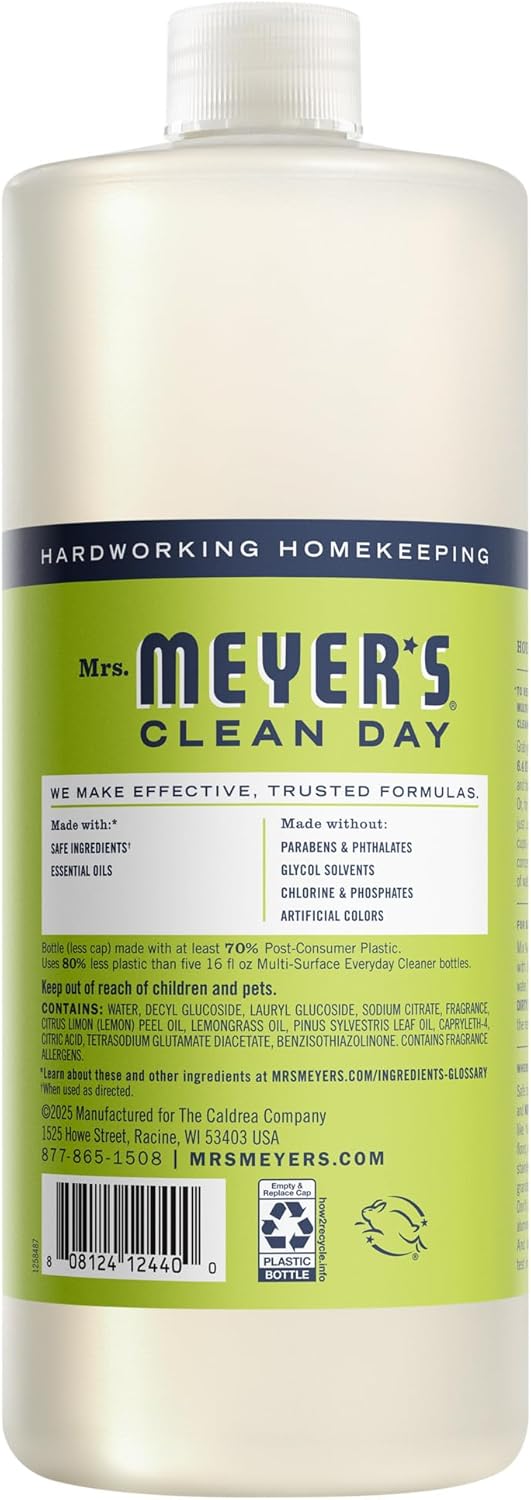
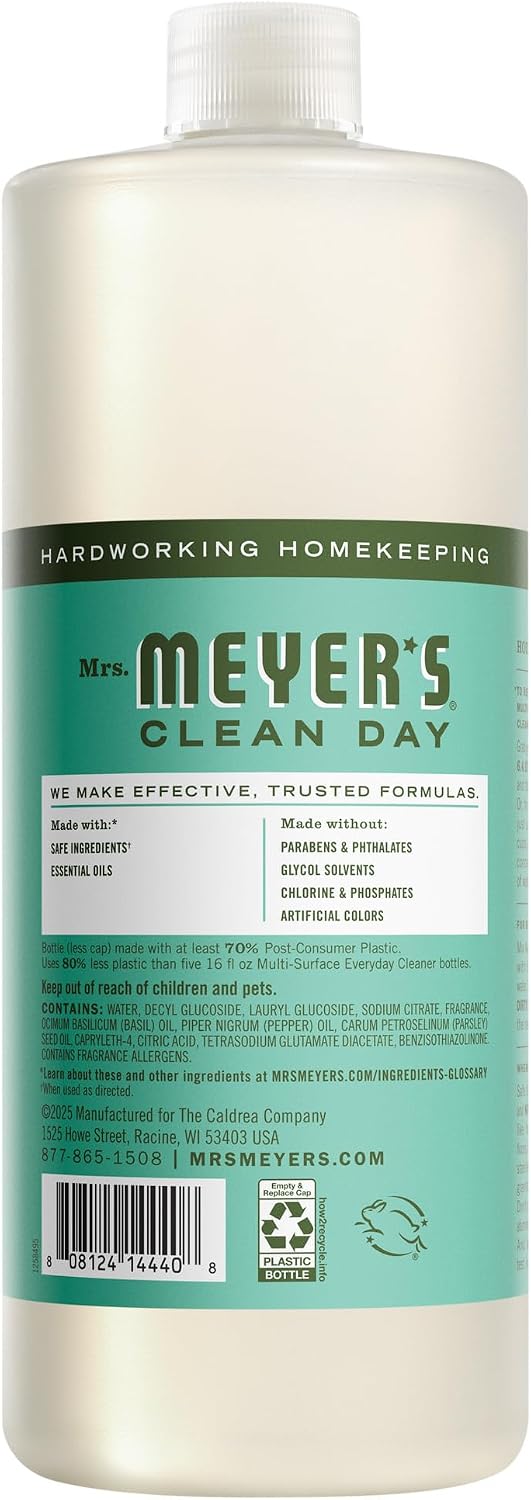
Mrs. Meyer’s is owned by S.C. Johnson and is the most fragrance-forward of the three. The brand leans heavily on garden-herb scenting — lavender, basil, geranium — as part of its identity. That’s relevant to certification status: fragrance formulations are typically disclosed only at the “fragrance” ingredient level on a label, not at the individual aromatic-compound level, and this creates tension with full-transparency standards.
Certifications confirmed: Mrs. Meyer’s holds EPA Safer Choice certification on select SKUs — primarily certain dish soaps and multi-surface sprays — but not across the full product line. EWG’s Guide to Healthy Cleaning grades individual Mrs. Meyer’s products variably, with some scoring in the B–D range depending on fragrance complexity. The brand is not EWG Verified as a line. It does hold Leaping Bunny cruelty-free certification.
What that means in practice: If fragrance matters to your client environment — residential clients who want the house to smell like a garden — Mrs. Meyer’s delivers a sensory experience that the other two brands don’t match. But if a client or facility requires full ingredient transparency, Mrs. Meyer’s fragrance approach creates a compliance gap that Safer Choice partially bridges on certified SKUs. You need to verify SKU-by-SKU, not assume the whole line qualifies.
Price point: Retail typically $4–$7 per 16 oz ready-to-use bottle in 2026. Concentrate refills are available but positioned as lifestyle accessories more than cost-reduction tools.
Method
$3.49
In stock on Amazon
Check price on AmazonMethod
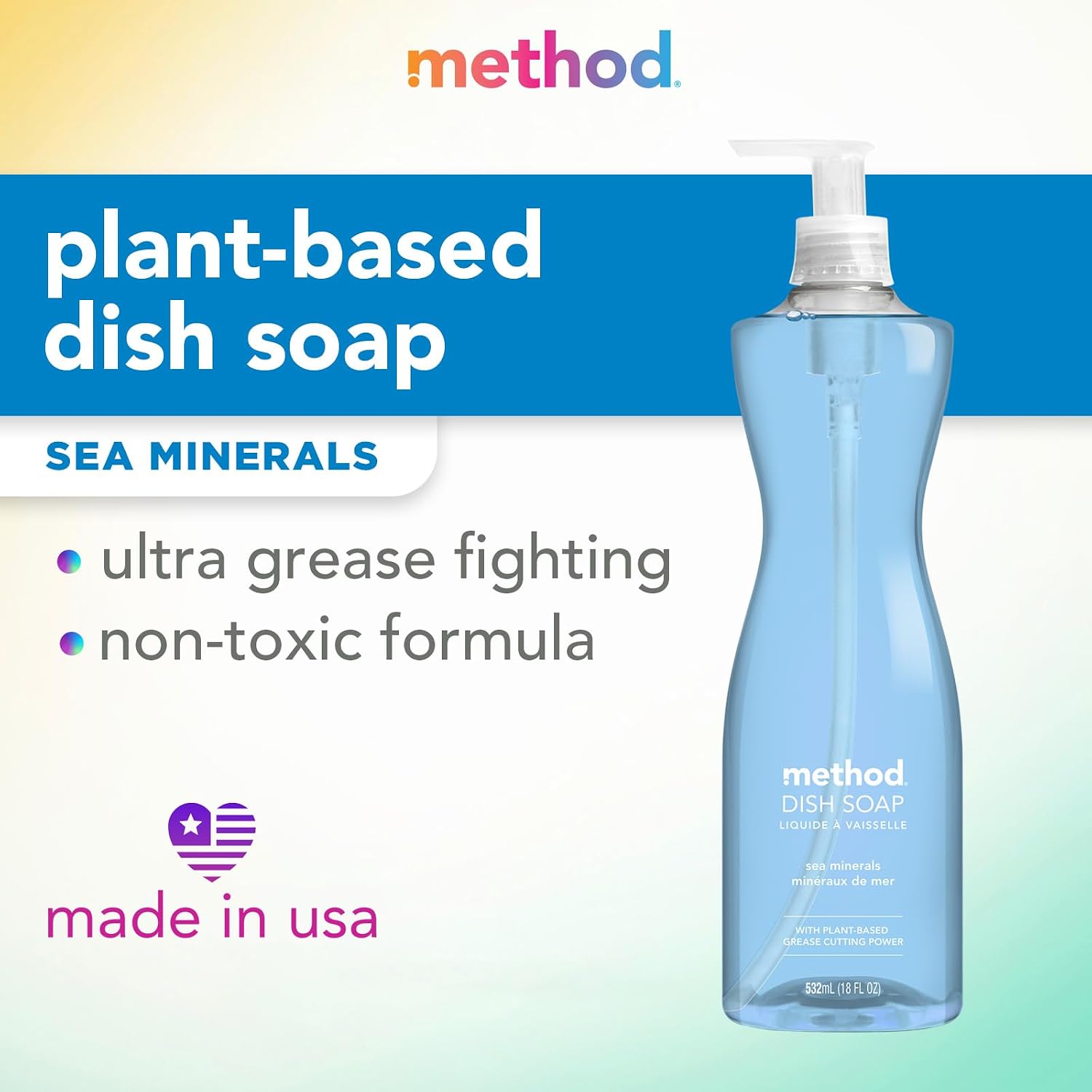
Method, now also part of SC Johnson (acquired 2017), built its reputation on design-forward packaging and being early to the EPA Safer Choice program. Method products carry EPA Safer Choice certification more broadly across their cleaning line than Mrs. Meyer’s does, and several SKUs are also EWG Verified. The brand has historically been one of the more transparent operators in the retail space on ingredient disclosure.
Certifications confirmed: EPA Safer Choice on core multi-surface, dish, and bathroom cleaners. EWG Verified on select products. Leaping Bunny certified. USDA Certified Biobased on some SKUs. Good Housekeeping’s 2025 eco-friendly cleaning products review recognized Method’s dish soap and all-purpose cleaner among its top picks for third-party verified formulas, citing the breadth of the brand’s Safer Choice coverage relative to competitors at the same price tier.
What that means in practice: Method is the strongest all-around certification story of the three brands at the retail price tier. If you’re building a cleaning kit for a client who wants to be able to point to specific third-party backing — and especially if that client responds to design aesthetics — Method hits both marks. The pump-bottle format and concentrated versions (particularly Method’s dish soap concentrates) also give operators a better cost-per-use ratio than comparable ready-to-use options. Wirecutter, in its Best Eco-Friendly Cleaning Supplies guide (New York Times / Wirecutter, updated 2025), consistently places Method dish and multi-surface products among its recommended picks for buyers prioritizing verified formulas over premium pricing.
Price point: $4–$9 per unit depending on format. Concentrates and refill pouches push the value case further; on a per-application basis, concentrated formats outperform ready-to-use volume-for-volume.
MRS.
$9.97
In stock on Amazon
Check price on AmazonSeventh Generation
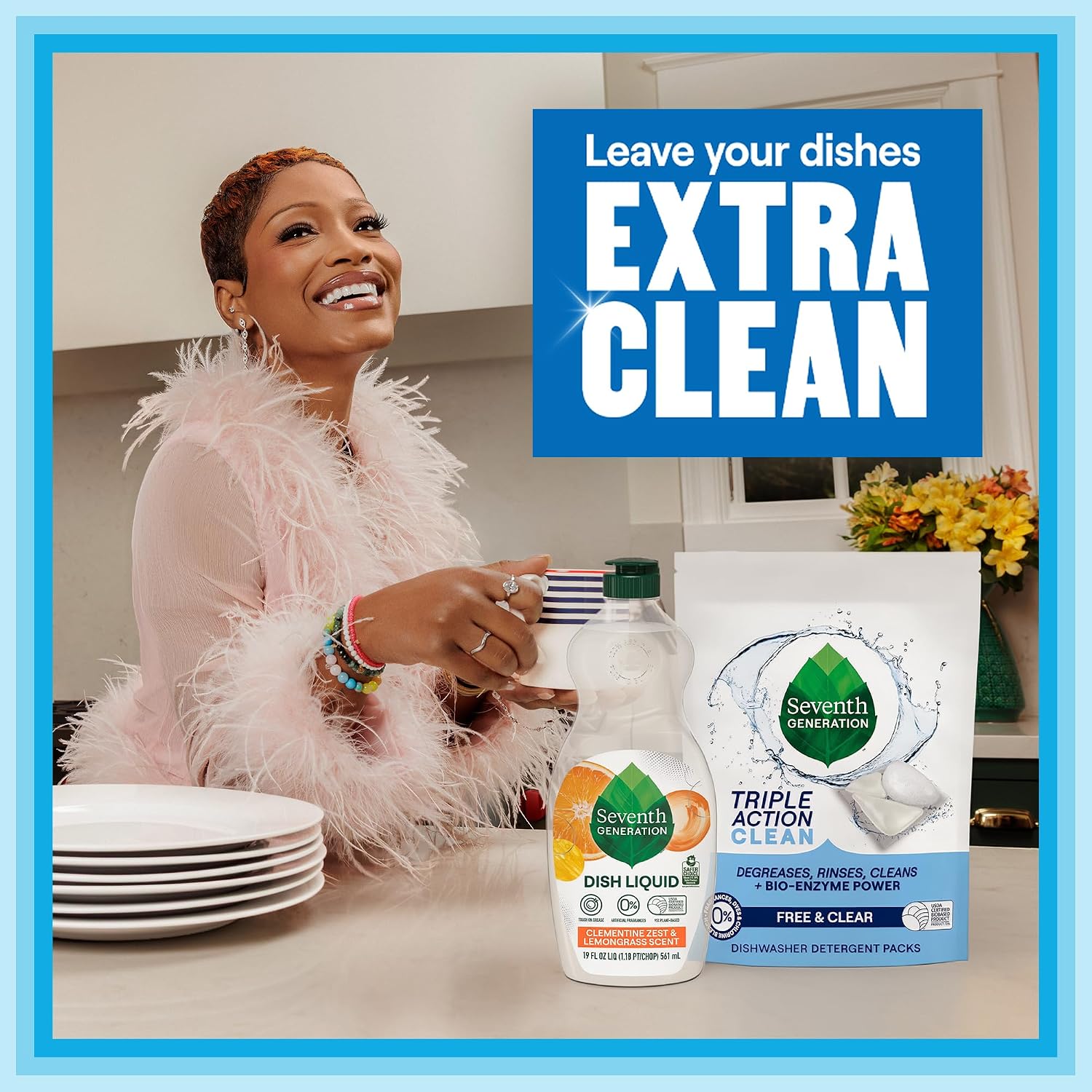
Seventh Generation is the outlier here in a meaningful way: it is primarily a performance and transparency brand rather than a sensory-experience brand, and it competes seriously in the “EPA registration” and “disinfecting” subcategory that neither of the above brands enters. Seventh Generation’s disinfecting multi-surface cleaner carries an EPA registration number — meaning the EPA has reviewed and accepted efficacy data for pathogen kill claims — a completely separate and more demanding process than Safer Choice certification.
Certifications confirmed: EPA Safer Choice on cleaning concentrates and dish products. EPA registration on specific disinfectant SKUs (an EPA registration number on a label means kill claims are federally verified; this is governed by the EPA’s pesticide registration process under FIFRA, documented at epa.gov, and is distinct from Safer Choice). EWG Verified across a broader product range than the other two brands. USDA Certified Biobased on several concentrates. Leaping Bunny certified. Wirecutter’s Best Eco-Friendly Cleaning Supplies guide (New York Times / Wirecutter, updated 2025) calls out Seventh Generation’s disinfecting spray as a standout for buyers who need verified pathogen claims without synthetic fragrance — a combination that is otherwise difficult to source at the retail tier.
What that means in practice: For operators working in healthcare-adjacent environments, daycares, schools, or any space where a client or contract requires documented disinfection efficacy, Seventh Generation is the only one of these three brands that competes in that lane. The EPA registration number is the credential that matters in those conversations — not Safer Choice, not EWG Verified alone. Seventh Generation also has a commercial and institutional line distributed through janitorial supply channels that extends the brand into higher-volume formats, though those are separate SKUs from the consumer retail bottles.
Price point: $5–$10 per unit retail. The institutional concentrate line, when available through janitorial distributors, shifts the per-use cost well below the retail bottle price.
Seventh
$21.18
In stock on Amazon
Check price on AmazonBy the Numbers
| Brand | EPA Safer Choice | EWG Verified | EPA Reg. (Disinfectant) | Leaping Bunny | USDA Biobased |
|---|---|---|---|---|---|
| Mrs. Meyer’s | Select SKUs only | No | No | Yes | No |
| Method | Broad line coverage | Select SKUs | No | Yes | Select SKUs |
| Seventh Generation | Broad line coverage | Broad line | Yes (disinfectant SKUs) | Yes | Select SKUs |
Certification status as documented in EPA Safer Choice program records (epa.gov/saferchoice), EWG’s Guide to Healthy Cleaning (Environmental Working Group), and published brand disclosures, as of May 2026. Certifications apply per product SKU, not per brand — verify the specific product before purchase.
The Trade-Offs No One Puts on the Label
Here’s where practitioners often get tripped up: these three brands are frequently treated as interchangeable because they occupy the same shelf position and price tier. They are not interchangeable once you map them to use cases.
Fragrance sensitivity matters more than you think. Mrs. Meyer’s strong scent profile is an asset in residential contexts where clients associate fresh fragrance with cleanliness. It becomes a liability in any space serving people with fragrance sensitivities, asthma, or chemical sensitivities. Industry guidance from ISSA (the Worldwide Cleaning Industry Association) on cleaning worker and occupant health identifies fragrance as one of the more common sources of indoor air quality complaints in commercial cleaning environments. Method and Seventh Generation both offer fragrance-free or lightly scented lines that hold up better in those settings.
“Plant-based” is not a safety claim. All three brands use some version of this phrase. The USDA BioPreferred Program’s Certified Biobased credential verifies origin of feedstock; it says nothing about whether a biobased ingredient is irritating, sensitizing, or environmentally persistent. EPA Safer Choice and EWG Verified are the credentials that evaluate ingredient safety — not the source of the raw material.
Concentrated formats are where the real cost-per-use math happens. At $6–$10 for a ready-to-use spray, all three brands look roughly equivalent. Shift to concentrated formats — Method’s dish concentrate, Seventh Generation’s institutional concentrates — and the per-use cost drops substantially. For operators running 20 or more residential accounts, the difference between diluting a concentrate at a 1:32 ratio versus buying ready-to-use is meaningful on a monthly basis. Good Housekeeping’s testing methodology for its 2025 eco-cleaning review explicitly accounts for cost-per-use in concentrate formats, which is why concentrates from both Method and Seventh Generation appear in its value picks despite higher sticker prices per unit.
Decision Framework: If X, Then Y
If your client or contract requires verified disinfection efficacy — healthcare-adjacent, school, daycare, or any space where kill claims need to be backed by federal review: → Seventh Generation disinfecting spray (confirm the EPA registration number on the specific SKU you purchase). Neither Mrs. Meyer’s nor Method competes in this lane.
If ingredient transparency is the primary criterion and you need the broadest third-party verified coverage across a full cleaning kit: → Method for most surfaces and dishes; Seventh Generation where you need EWG Verified breadth across more of the line. Both outperform Mrs. Meyer’s on documented full-line certification coverage.
If the client environment is residential and fragrance is a selling point — the client wants to notice the clean and associate it with a pleasant scent: → Mrs. Meyer’s wins on sensory experience. Confirm you are purchasing a Safer Choice-certified SKU if you need to maintain an eco-credential conversation with the client.
If you are evaluating cost-per-use for a multi-account cleaning operation and are currently buying ready-to-use at retail: → Run the math on Method or Seventh Generation concentrated formats. Published dilution ratios from both brands put the per-application cost of their concentrates meaningfully below ready-to-use equivalents — the exact savings depend on your dilution discipline and local retail pricing, but the direction of the math is consistent.
The certifications are public, the standards are documented by the EPA, EWG, USDA BioPreferred, and Leaping Bunny, and the trade-offs are real. Reading the label is a starting point — reading the program requirements behind the label is where the decision actually gets made.